

Mortgage Portfolio Optimization

Andrew Paolillo
In addition to selling new production loans through the Mortgage Partnership Finance® (MPF®) Program, selling seasoned loans can be a useful tool to navigate different risks and adjust the composition of both the asset and liability sides of the balance sheet.
The Path of Mortgage Rates
Mortgage sales are often viewed through the lens of the execution price, but a more meaningful approach to evaluation may be how a sale supports an institution’s broader balance sheet strategy. Depending on the composition of a portfolio and the path and current level of interest rates, depository institutions may have several opportunities—from repositioning deeply discounted legacy loans to monetizing seasoned loans trading near or just above par—to improve liquidity, manage interest-rate risk, enhance future earnings, or redeploy capital.
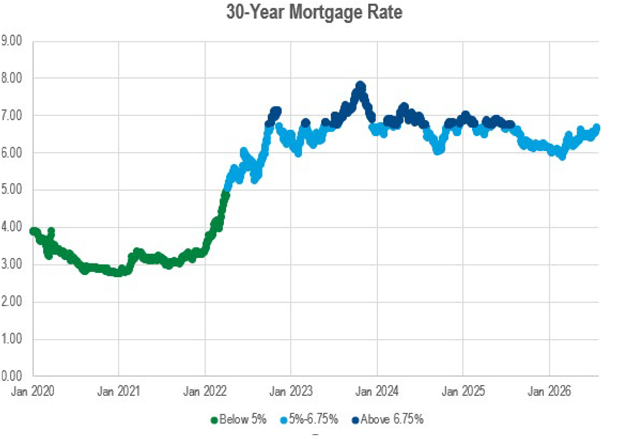
Consider the chart below, which shows 30-year mortgage rates from January 2020 to July 2026. In the current environment, conventional mortgages held on balance sheet generally fall into three distinct categories for possible restructuring:
- Loans originated in 2020 and 2021, at rates below 5% (highlighted in dark green);
- Loans originated at various points between 2022 and 2026, with coupons between 5% and 6.75% (highlighted in light blue); or
- Loans originated at various points between 2022 and 2025, with coupons above the approximate current mortgage rate of 6.75% (highlighted in dark blue).
Assessing opportunities to sell seasoned loans can be beneficial and can complement the core secondary market activity of selling newly originated loans at a modest premium to par.
Assessing opportunities to sell seasoned loans can be beneficial and can complement the core secondary market activity of selling newly originated loans at a modest premium to par. Below we outline three strategies members can use to support the ever-changing challenge of balancing earnings, growth, liquidity, and interest-rate risk.
Strategy #1: Selling Loans with Coupons Between 5% and 6.75%
Loan growth in sectors such as commercial real estate, commercial and industrial, and autos, where demand is not as sensitive to the path and level of interest rates as mortgages, has remained strong, driving robust economic performance that has spurred the Federal Reserve to slow the pace of rate cuts. Additionally, home equity lending has accelerated, filling the gap left by reduced refinancing activity in mortgages.
Selling loans just slightly under par ($95-100), or between par and the typical sales price for new origination ($100-102), can help banks and credit unions efficiently fund incremental loan demand without growing the balance sheet, at a time when conditions for deposit gathering and retention are challenging. Consider the table below, which outlines two approaches to selling residential loans and redeploying the proceeds to optimize earnings, interest-rate risk, and liquidity.
| Strategy | Redeployment | Impact |
|---|---|---|
| Sell at a slight loss (ex., $98) | To fund wider spread loan sectors (CRE, autos, etc.) | Slight income statement loss can be earned back quickly. Also, shorter asset duration and a more favorable prepayment profile reduces interest-rate risk. |
| Sell at par to slight premium ($100-101) | To fund new mortgages at higher rates | No negative impact on income or loan concentrations but going-forward margin enhancements from new rates that are 50-75 bps higher. |
Strategy #2: Selling Loans with Coupons Above 6.75%
As the image below shows, not only are current mortgage rates lower than the peaks briefly achieved in 2023, but also spreads relative to the Treasury curve are also narrower than when mortgage rates were above 7%.
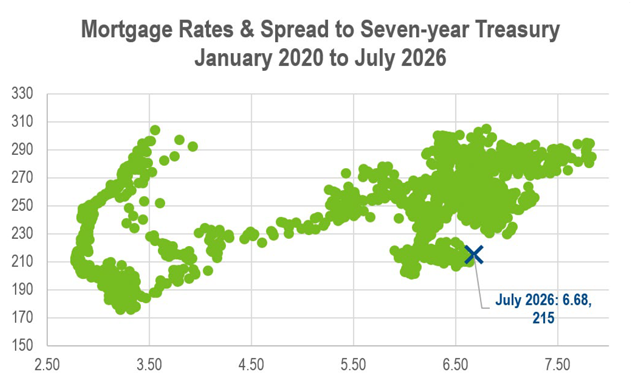
This narrowing of spreads combined with lower rates can lead to pricing improvement. However, as depository balance sheet managers are aware, valuation increases plateau when rates move lower, as incentives are created for borrowers to refinance, increasing prepayment risk and potential margin contraction. Continued strength in home prices in New England has made refinancing accessible for borrowers who may have initially closed their loans with rates near the current highs.
As noted in the June 2026 ALM, Liquidity & Funding Strategies Webinar, yields on residential loan portfolios for New England banks and credit unions contracted in the first quarter, despite the marginal rate for mortgages far exceeding the portfolio yield. This suggests the highest-rate loans in the portfolio are exhibiting elevated levels of prepayment activity and causing margin pressure. Selling these seasoned high-coupon loans through the MPF Program can help preserve margins and maintain stable levels of liquidity and interest-rate risk, and generate more non-interest income than a typical new origination sale.
Strategy #3: Selling Loans with Coupons Below 5%
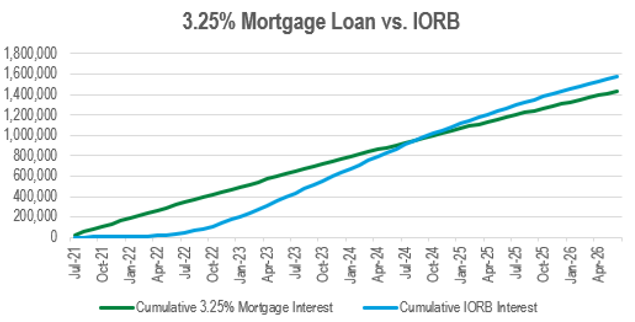
Selling mortgages with low coupons can be a more involved process because of the hesitation to avoid realizing losses. However, the opportunity cost of holding below-market-yielding assets accumulates gradually over time through lower earnings, reduced flexibility, and elevated interest-rate risk. As the chart below shows, the cumulative interest received from holding an initial balance of 3.25% mortgages, beginning in June 2021, was surpassed by rolling cash held in Interest on Reserve Balances (IORB) after roughly three years, despite IORB starting over 300 basis points lower at just 0.15%.
When contemplating selling seasoned loans, there are several balance sheet and income statement considerations to factor in:
- Capital: Do you have the ability and willingness to absorb a near-term hit to capital, and allow margin enhancement to earn back the loss in an appropriate timeframe?
- Redeployment: The appeal of the math behind selling seasoned loans will be influenced by where the sale proceeds will be put to work. Are the funds going into wider-spread loan types that will accelerate the earn-back period? Or is the intent to reposition into investments to recalibrate interest-rate risk and/or liquidity ratios into a preferred range?
- Asset allocation and growth: Is the sale motivated by a strategic goal to expand loan types with shorter durations such as home equity loans or adjustable-rate mortgages? Is the cash being used to de-lever and slow balance sheet growth by paying down funding where the rate may be very close to or even exceed the asset yield? Selling seasoned loans as part of a balance sheet restructuring related to a merger or acquisition can be a useful tool in aligning the risk and return profiles of the combined.
Flexible Funding
Recent market conditions have created challenges and opportunities for FHLBank Boston members. Our Financial Strategies group has developed a suite of analytical tools designed to help you identify the funding solutions that best fit the unique needs of your balance sheet. Please contact me at 617-292-9644 or andrew.paolillo@fhlbboston.com or reach out to your relationship manager for more details.
FHLBank Boston does not act as a financial advisor, and members should independently evaluate the suitability and risks of all advances. The content of this article is provided free of charge and is intended for general informational purposes only. FHLBank Boston does not guarantee the accuracy of third-party information displayed in this article, the views expressed herein do not necessarily represent the views of FHLBank Boston or its management, and members should independently evaluate the suitability and risks of all advances. Forward-looking statements: This article uses forward-looking statements within the meaning of the “safe harbor” provisions of the Private Securities Litigation Reform Act of 1995 and is based on our expectations as of the date hereof. All statements, other than statements of historical fact, are “forward-looking statements,” including any statements of the plans, strategies, and objectives for future operations; any statement of belief; and any statements of assumptions underlying any of the foregoing. The words “expects”, “may”, “likely”, “could”, “to be”, “will,” and similar statements and their negative forms may be used in this article to identify some, but not all, of such forward-looking statements. The Bank cautions that, by their nature, forward-looking statements involve risks and uncertainties, including, but not limited to, the uncertainty relating to the timing and extent of FOMC market actions and communications; economic conditions (including effects on, among other things, interest rates and yield curves); and changes in demand and pricing for advances or consolidated obligations of the Bank or the Federal Home Loan Bank system. The Bank reserves the right to change its plans for any programs for any reason, including but not limited to legislative or regulatory changes, changes in membership, or changes at the discretion of the board of directors. Accordingly, the Bank cautions that actual results could differ materially from those expressed or implied in these forward-looking statements, and you are cautioned not to place undue reliance on such statements. The Bank does not undertake to update any forward-looking statement herein or that may be made from time to time on behalf of the Bank.
As vice president, director of member lending & strategies at FHLBank Boston, Andrew leads the financial strategies group in creating customized funding strategies for members.

