

Non-Match Funded Strategies for Insurance Companies

Andrew Paolillo
The deep menu of FHLBank Boston advance products affords insurance company members the ability to use funding in both strategic and tactical ways.
Spread Lending & Liquidity Management
For most insurance companies, utilization of FHLBank Boston advances comes in the form of match-funded spread lending activity and shorter-term liquidity management efforts. With spread lending, it is typical for members to match the interest-rate risk profile of the liabilities to that of the asset(s), isolating the return and exposure profile solely on the excess credit and liquidity spread. Matching interest-rate risk may afford favorable treatment in the eyes of ratings agencies, allowing for the transaction to be treated as operating, versus financial, leverage. With liquidity management, the just-in-time nature of advances allows insurance companies to smooth out short-term cash flows, such as unexpected claim activity, and reduce cash drag and reliance on selling assets to meet liquidity needs.
There is an approach that allows insurance companies to manage risk and return from a top-down perspective, syncing with overall balance sheet needs and shifting opportunities that arise from a volatile macroeconomic environment.
In addition to these two strategies, there is an approach that allows insurance companies to manage risk and return from a top-down perspective, syncing with overall balance sheet needs and shifting opportunities that arise from a volatile macroeconomic environment. Below we outline three strategies that insurance companies can adopt to enhance return and manage risk.
Strategy #1: Hedging Exposure to Lower Rates
A challenge for balance-sheet-driven investors like insurance companies is that the supply of, demand for, and pricing of targeted assets may differ from that of the liability side of the balance sheet, particularly in different or changing interest-rate environments. Many life insurance companies tend to outperform in higher versus lower interest-rate environments. A key driver of that is that higher discount rates lower/improve the present value of long-term liabilities that comprise a diversified life insurance book. Additionally, the nominal return on the marginal invested asset is higher. As such, sustained and sharply lower interest rates have likely led to a reduction in earnings, independent of shifts in volumes and growth.
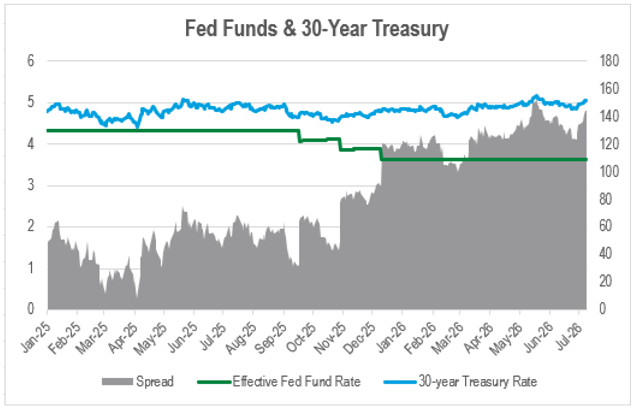
One way to address this exposure to lower rates is to utilize short-term or floating-rate advances to fund the addition of long-term fixed-rate assets. This strategy differs from a traditional spread lending program because it is more focused on big-picture interest-rate risk exposures of the balance sheet than the appeal of spreads in a particular sector. Floating-rate advances like the Discount Note Auction-Floater Advance and the Callable SOFR-Indexed Floater Advance give members the ability to add funding with very short durations that, when paired with the longer durations of the invested assets, could bring the overall interest-rate risk exposure towards a more neutral posture.
Additionally, these advances allow members to pay off the advance before maturity without being subject to a prepayment fee, affording great flexibility to revisit and shift strategy, as necessary. The pivot to a more hawkish rate environment in 2025 and 2026 has led to a steeper yield curve, such that there is more day-one spread attainable in this strategy, to add to the benefits of the protection if rates move significantly lower.
Strategy #2: Pulling Reinvestment Activity Forward
In the normal course of business, the proceeds from maturing assets and cash generated from premium inflows are directly reinvested, one for one, back into assets in line with the overall investment strategy. However, there are times when market conditions make reinvestment prospects relatively appealing due to the nominal yield, the spread, or both. This may create a scenario where the appetite to add those assets exceeds the cash flow coming in. In this instance, short-term advances can be leveraged to generate the cash needed to take advantage of these market dislocations. For example, a customized ladder of Classic Advances can be leveraged to create the capacity to add more assets in the current environment.
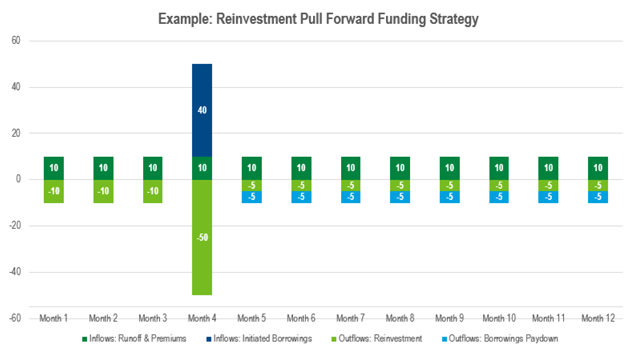
The chart above shows an example where an insurance company member might expect to receive $10 million in monthly cash flow, which is typically promptly reinvested in the broader portfolio. However, if in month four the member wanted to take advantage of more favorable conditions (a rate sell off, a widening of spreads, etc.), then they could utilize $40 million in short-term Classic Advances to allow for purchases of $50 million in that month. In this example, we assume purchases in subsequent months slow to $5 million per month, allowing for $5 million of cash flow to be used to pay down the advances over time. Advances are flexible and highly customizable, allowing the maturity profile to be positioned in several ways to align with overall balance sheet positioning and the assessment of further relative value opportunities.
Strategy #3: Taking Advantage of Favorable Long-Term Rates
In contrast to the previous strategy, where dislocations in asset yields and spreads serve as the driver for initiating funding, other instances can be primarily influenced by liability pricing. In periods when interest-rate volatility increases, long-term rates rally and/or the yield curve becomes inverted, FHLBank Boston advance pricing quickly adapts to changing market rates.
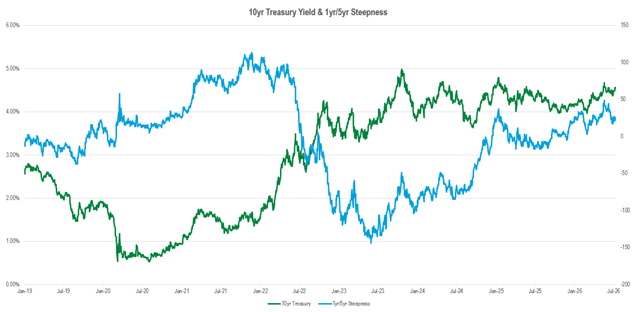
The chart above shows the path of the 10-year Treasury rate, as well as the steepness between one-year and five-year Treasurys. With the benefit of hindsight, it’s noted that the 10-year persisted below 2% for almost two and a half years before accelerating through 3% and above 4% in 2022. Accordingly, advance rates closely tracked that move, creating the opportunity to lock in extremely favorable rates on long-term funding.
| Advance Type | Advance Structure | Advance Rate | Date of Advance |
|---|---|---|---|
| Forward Starting Advance | One-year delay, four-year maturity | 3.88% | 5/31/23 |
| HLB-Option Advance | Five-year maturity, one-year lockout, putable quarterly | 3.52% | 5/31/23 |
While long-term rates bottomed in 2020, parts of the yield curve did not reach maximum inversion until 2023. Inverted yield-curve environments can make solutions like the Forward Starting Advance and the HLB-Option Advance appealing funding options. When the yield curve is inverted, forward rates are below cash rates, given the market expectation that interest rates might fall in the future. Ultimately, rate cuts did not materialize as expected, so members who initiated FSAs at that time would have had funding disbursed at rates well below current levels. As shown in the table above, an FSA with a one-year delay period that ultimately disbursed as a four-year maturity was priced in the high 3% range, at a time when short-term interest rates were above 5% and long-term rates were above 4%.
For members who wanted immediate access to liquidity as opposed to the delay period afforded by the FSA, the HLB-Option Advance benefits from yield-curve inversion as well, with additional support from favorable spreads when interest-rate volatility increases. A structure with a five-year maturity, a one-year lockout period where the advance could not be put back to the member by FHLBank Boston, and then putable quarterly thereafter was priced at 3.52% in May 2023, which at the time was a savings of 182 basis points vs. the one-year Classic Advance.
Flexible Funding
Recent market conditions have created challenges and opportunities for FHLBank Boston members. Our financial strategies group has developed a suite of analytical tools designed to help you identify the funding solutions that best fit the unique needs of your balance sheet. Please contact me at 617-292-9644 or andrew.paolillo@fhlbboston.com or reach out to your relationship manager for more details.
FHLBank Boston does not act as a financial advisor, and members should independently evaluate the suitability and risks of all advances. The content of this article is provided free of charge and is intended for general informational purposes only. FHLBank Boston does not guarantee the accuracy of third-party information displayed in this article, the views expressed herein do not necessarily represent the views of FHLBank Boston or its management, and members should independently evaluate the suitability and risks of all advances. Forward-looking statements: This article uses forward-looking statements within the meaning of the “safe harbor” provisions of the Private Securities Litigation Reform Act of 1995 and is based on our expectations as of the date hereof. All statements, other than statements of historical fact, are “forward-looking statements,” including any statements of the plans, strategies, and objectives for future operations; any statement of belief; and any statements of assumptions underlying any of the foregoing. The words “expects”, “may”, “likely”, “could”, “to be”, “will,” and similar statements and their negative forms may be used in this article to identify some, but not all, of such forward-looking statements. The Bank cautions that, by their nature, forward-looking statements involve risks and uncertainties, including, but not limited to, the uncertainty relating to the timing and extent of FOMC market actions and communications; economic conditions (including effects on, among other things, interest rates and yield curves); and changes in demand and pricing for advances or consolidated obligations of the Bank or the Federal Home Loan Bank system. The Bank reserves the right to change its plans for any programs for any reason, including but not limited to legislative or regulatory changes, changes in membership, or changes at the discretion of the board of directors. Accordingly, the Bank cautions that actual results could differ materially from those expressed or implied in these forward-looking statements, and you are cautioned not to place undue reliance on such statements. The Bank does not undertake to update any forward-looking statement herein or that may be made from time to time on behalf of the Bank.
As vice president, director of member lending & strategies at FHLBank Boston, Andrew leads the financial strategies group in creating customized funding strategies for members.

