For nearly 95 years, FHLBank Boston has served as a trusted partner to its members, helping to foster economic growth and stability across the region by providing reliable wholesale funding and liquidity. In 2025, FHLBank Boston maintained its ongoing commitment to serve member financial institutions, helping them advance affordable housing and economic development throughout New England. FHLBank Boston and the FHLBank System’s efforts were highlighted on a national scale in late 2025 when independent research from the Urban Institute revealed that the FHLBanks deliver $13.2 billion to $21.4 billion in annual economic value by serving as a critical liquidity backstop that strengthens bank stability, reduces systemic risk, and helps prevent bank failures during periods of financial stress.
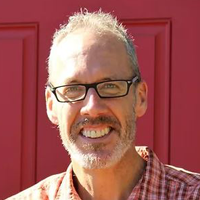
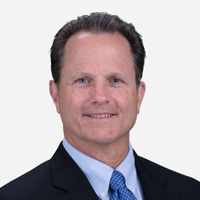
Learn more about how FHLBank Boston supports New England by reading this report and viewing the short video below. See perspectives from FHLBank Boston President & Chief Executive Officer Timothy J. Barrett, Board Member and bankESB Chief Strategy Officer William M. Parent, and Advisory Council Vice Chair and Maine Housing Director Dan Brennan.
The Bank had a really good year in 2025. We saw a steady activity from our members. We saw some focus in our residential mortgage activities, our MPF activities. Members were very in tune to the change in administration, the change in the regulatory environment, so we spent a lot of time educating them as to what the impact would be at our Bank.
We also engaged with our members in a way I think this year more than even previous years. We’re out in the community quite a bit. Our HCI team was out to all the states. Our board was out to two states this year. We’re going to continue that next year.
The outreach that the Federal Home Loan Bank does with their partners and other organizations is among the more robust that I have seen in my travels. They are constantly on the road. They are constantly engaging. They do a very good job at listening and hearing what the various diverse needs of New England are.
2025 was another stellar year. I think it was the top five year of earnings, and therefore that money gets allocated to our affordable housing programs. 10% goes to our statutory AHP, and this year in 2025, we were able to give at least another 10% to our voluntary programs.
The Federal Home Loan Bank System is a catalyst working with our member banks by providing funding, programs, and advances to member banks so that they can help with construction and really go at creating a larger stock of housing availability in New England.
We’ve been in a situation in New England where housing costs are rising dramatically faster than incomes are. The uniqueness of the programs is the impact they have on people that are most in need. The programs help those that are struggling, help those that need that one extra step to get into their first home, get into an affordable apartment. And they have a direct impact on that. And when they do that, the Bank succeeds, the Bank is fulfilling its mission.
We use the Home Loan Bank to offer down-payment assistance of over $3 million to first-time homebuyers. We also use the MPF Program to sell over $30 million of loans. By offering and having access to sell loans to the Federal Home Loan Bank, it offers an opportunity to actually provide even more credit to homebuyers in our communities.
It’s also worth mentioning that the Bank increased its on-balance sheet liquidity position for our members. We’re at a position now where a lot of our lending is sourced through this on-balance sheet liquidity. We have great access to the markets. We can continue to borrow money to meet the needs of our members, but in 2025 we saw a dramatic increase of on-balance sheet liquidity that provides easy access to our members in any economic cycle.
What makes small businesses confident that they can get access to their money in an efficient way and also provides members the opportunity to provide them credit and leverage so that they can grow their businesses, they can invest in their communities. That’s a really critical and important overall role that we play at the Federal Home Loan Bank as a catalyst for the New England economy overall.
Looking ahead in 2026, we’re going to build on the success of 2025. We have some aggressive goals to continue to expand our lending, especially with insurance companies and in the MPF market. We look forward to engaging even more with our members. We’re going to visit all the states again this year, and the board’s on the road as well. And we look forward to another great year.
The Bank increased its on-balance sheet liquidity position for our members. We’re at a position now where a lot of our lending is sourced through this on-balance sheet liquidity. We have great access to the markets. We can continue to borrow money to meet the needs of our members.
Timothy J. Barrett
President, Chief Executive Officer
FHLBank Boston
Our Mission
The mission of the Federal Home Loan Bank of Boston is to provide highly reliable wholesale funding and liquidity to member financial institutions throughout New England. We strive to deliver the best financial products, services, and expertise that support home financing, affordable housing, and community development, including programs targeted to lower-income households.
In 2025, FHLBank Boston’s financial results were shaped by changing interest rate conditions and member demand for advances. Member utilization of the Mortgage Partnership Finance® (MPF®) Program grew significantly. Additionally, the Bank contributed $32.6 million to the Affordable Housing Program and $31.4 million for affordable housing and community investment programs like Housing Our Workforce, Lift Up Homeownership, Jobs for New England, the CDFI Advance program, and the MPF Permanent Rate Buydown product.
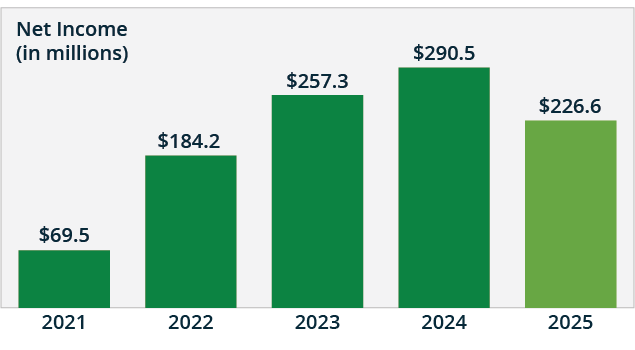
Net income was $226.6 million in 2025, a $63.9 million decrease from $290.5 million in 2024. The drop in income was driven primarily by a decrease of $56.2 million in net interest income after provision for credit losses, and an increase of $11.1 million in discretionary housing and community investment programs expense and voluntary Affordable Housing Program contributions.
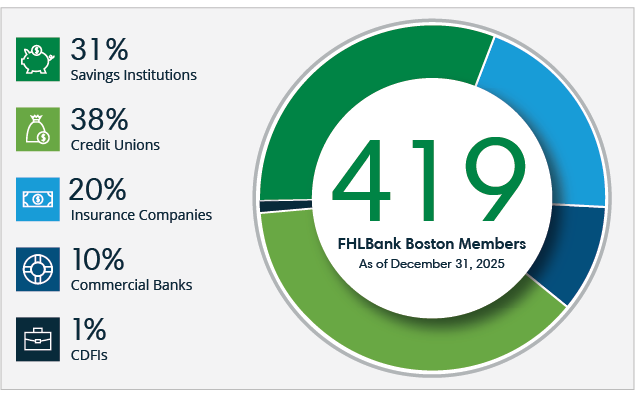
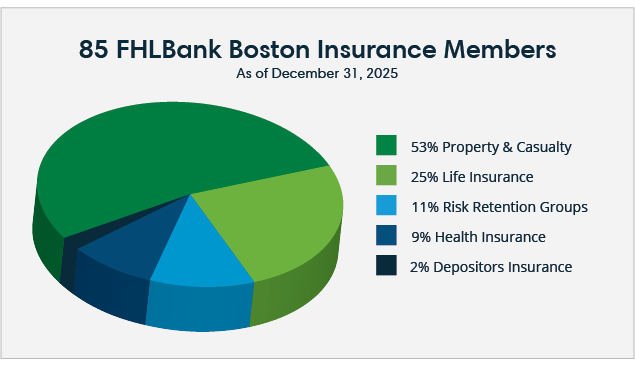
FHLBank Boston’s membership is comprised of banks, credit unions, insurance companies, and Community Development Financial Institutions of varying sizes. We view our members as partners to whom we provide access to reliable funding and experts to help them with strategic solutions for managing interest-rate volatility, reducing funding costs, optimizing mortgage funding, and supporting communities’ economic development and affordable housing needs. We welcomed nine new members in 2025: six insurance companies, two credit unions, and one bank.
Odyssey Reinsurance Company is pleased to be a member of Federal Home Loan Bank Boston. This relationship represents an important part of our financial and investment strategy as it enables us to access a strong, flexible source of liquidity.
Richard F. Coerver IV
Executive Vice President, Chief Financial Officer Odyssey Reinsurance Company (member since 2024)
Members relied on a range of FHLBank Boston financial products and solutions to help them strengthen and support their communities in 2025. FHLBank Boston’s flexible offerings include advances, a secondary-market mortgage program, and letters of credit. The offerings can be tailored to allow members to address specific needs in a changing economic environment and maintain their commitment to serving New England communities. The MPF Permanent Rate Buydown product, launched in 2024 and offered again in 2025, provided mortgage rates up to 2% below market for 243 lower-income borrowers. See below for more on the product’s impact.
Advances
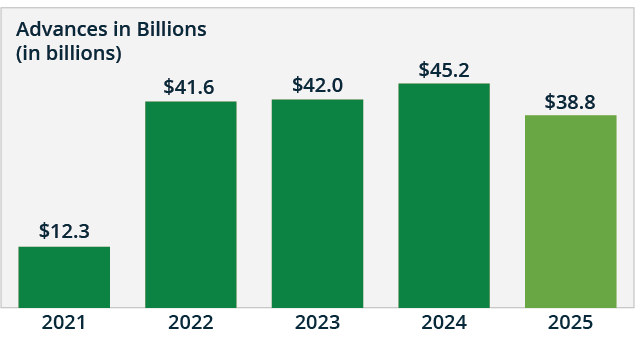
In 2025, advances helped members manage a shifting rate environment. Markets moved from “higher for longer” expectations to gradual cuts, while volatility remained elevated and the yield curve stayed uneven. Members leveraged advances as a way to stay nimble when rate paths were unclear.
FHLBank Boston advances are a planned, readily available, and flexible funding tool that helps keep our balance sheet nimble. Advances have evolved into a core liquidity and asset-liability management strategy that we view as supportive, and as we take actions to adjust to shifting economic conditions.
Bob Morgan
Chief Executive Officer
NorthCountry Federal Credit Union
Mortgage Partnership Finance®
Members can use the MPF Program to increase balance-sheet liquidity and improve profitability. By selling eligible loans into the program, members can support growth in priority assets and avoid concentrating long-term assets on their own balance sheet. Due to growing interest in the Program, the MPF team expanded in 2025 to better serve members. Also, the Permanent Rate Buydown (PRB) product continued to attract members by offering up to a 2% reduction in mortgage interest rates for eligible borrowers, those earning up to 80% of the area median income. Members delivered 243 loans to PRB in 2025, with 78% of those being first-time homebuyers.
Coastal1’s participation in the 2025 Permanent Rate Buydown program through FHLBank Boston allows us to deliver immediate, long-term affordability to our borrowers by lowering the interest rates from day one. This creates meaningful monthly savings and makes homeownership a more attainable goal for families in our community. The program is a powerful tool that aligns with both our core values of ‘People Helping People’ and our lending strategy, creating a lasting impact for the members we serve.
Kevin Farrell
Chief Lending Officer
Coastal1 Credit Union
“Mortgage Partnership Finance” and “MPF” are registered trademarks of the Federal Home Loan Bank of Chicago.
Letters of Credit
FHLBank Boston’s Letters of Credit (LOCs) continued to provide members with a flexible, cost-effective alternative to pledging securities. Members used LOCs to back deposits from state and municipal entities, provide credit support for taxable and tax-exempt bonds, and guarantee contractual performance on their own behalf and on behalf of customers. This allowed members to unencumber high-quality securities, improve balance-sheet liquidity metrics, and better align their asset-liability management strategies while maintaining and growing important municipal and public-sector relationships.
Profile Bank has been a longtime user of the FHLBank Boston’s Letters of Credit (LOCs). It is a cost effective, user-friendly way to easily collateralize our local and state government deposits. Their Online Banking platform makes it efficient with retained beneficiary details, and also automatically emails the LOCs to our customers. The icing on the cake is the ease of acceptance by the beneficiaries, as they already know the strength of the FHLBank System.
Kevin Miller
President, Chief Executive Officer
Profile Bank
Community Impact
Across FHLBank Boston, employees share a commitment to creating meaningful impact for our New England-based members and communities. Through active participation in volunteer initiatives connected with FHLBank Boston’s mission, such as organizations that promote financial literacy, hunger relief, support for local homelessness and poverty relief efforts, among many others, employees make a meaningful difference.
We demonstrate our commitment to the community through volunteering and developing partnerships with nonprofit organizations aligned with our mission.
Amy Iseppi
Vice President, Director of Government and Community Relations
FHLBank Boston
Mission Led
Like our members, FHLBank Boston employees are committed to making a positive impact in New England. The Bank supports mission-aligned nonprofit organizations through sponsorships and employee volunteer opportunities. In 2025, these efforts included partnerships with organizations such as Habitat for Humanity, Boston Area Gleaners, St. Francis House, Pine Street Inn, Women’s Lunch Place, Bridge Over Troubled Waters, and Christmas in the City, among others. In addition, FHLBank Boston collaborated with local organizations, including the Massachusetts Bankers Association and the Boston City Council, to provide educational programming for employees.
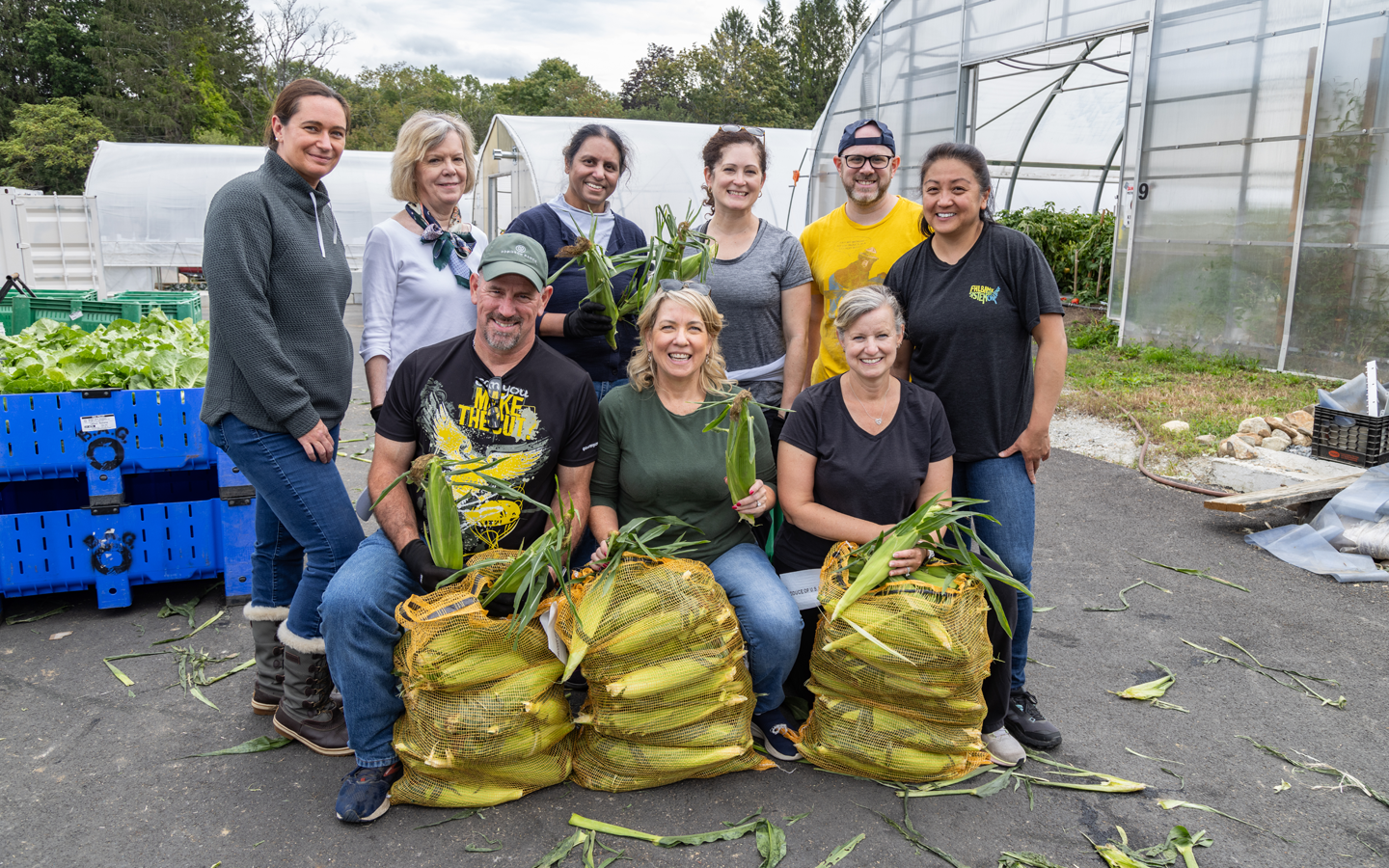
Boston Area Gleaners
Volunteers gathered surplus crops and packed them for donation to food banks, pantries, community kitchens, and other food-access initiatives.
Women’s Lunch Place
Bank employees helped kitchen staff at the Women’s Lunch Place to prepare healthy and delicious breakfasts and lunches for women who are experiencing homelessness or trauma in their lives.
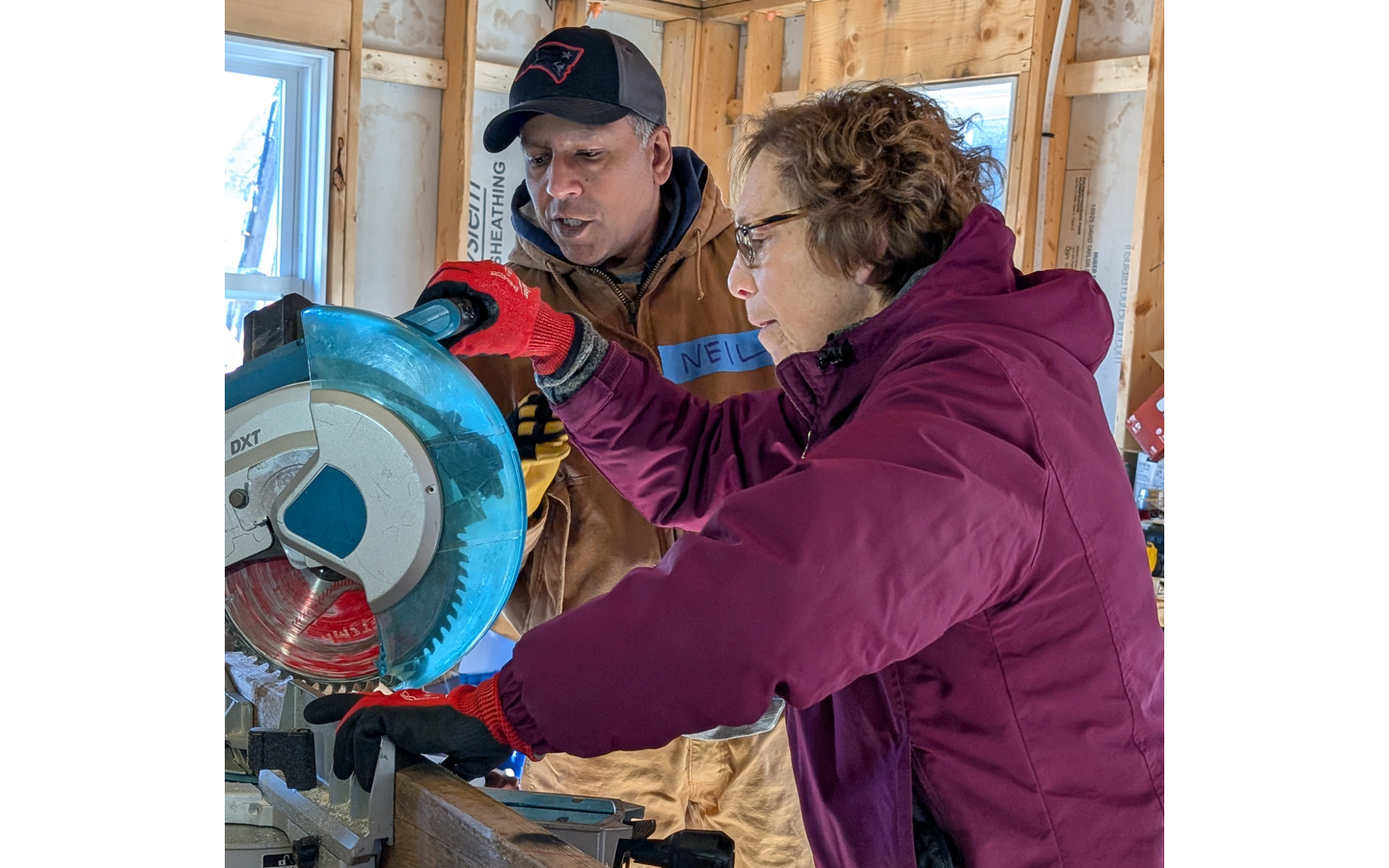
Women & Allies Business Resource Group Build for Habitat for Humanity
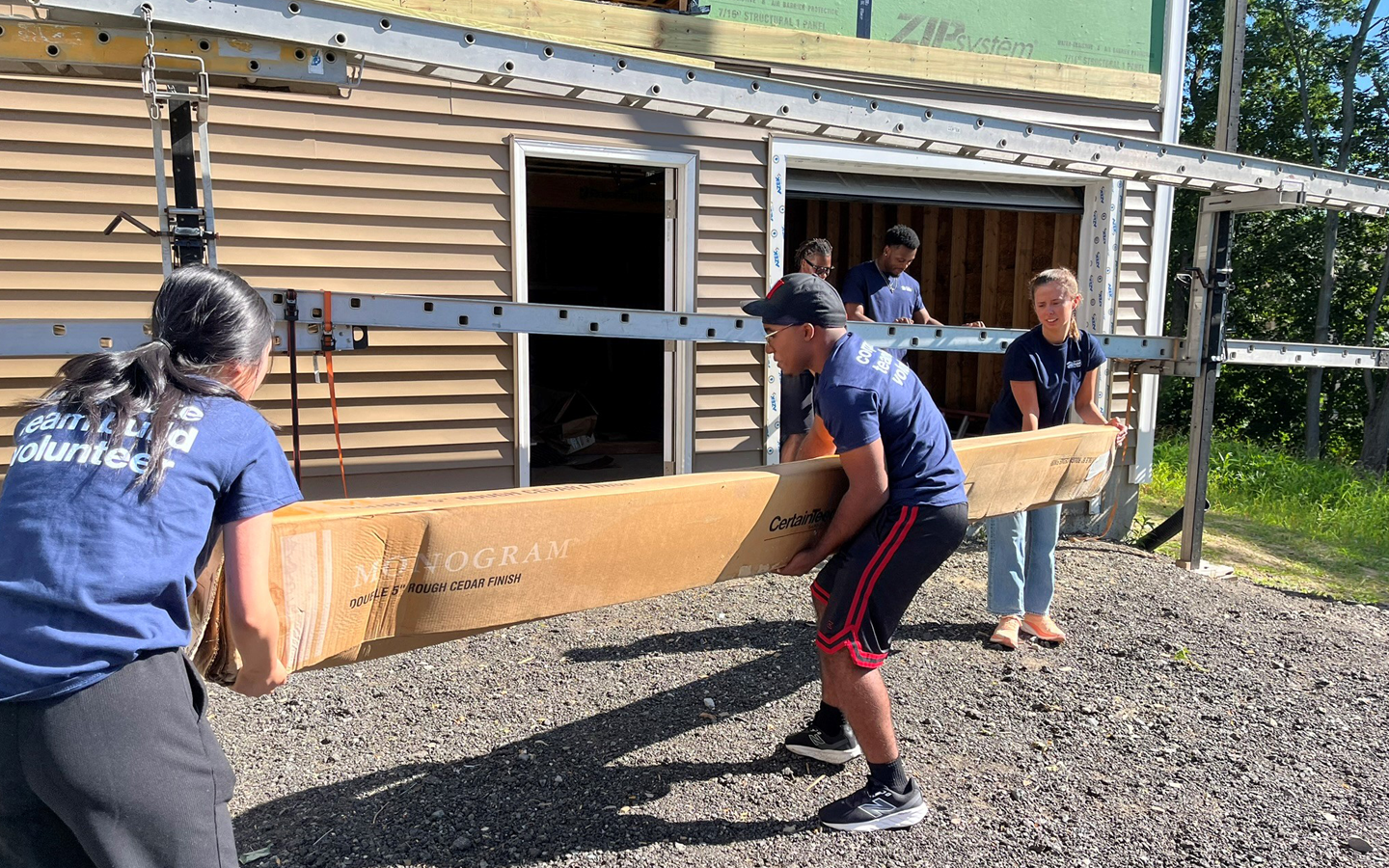
The Bank’s Women & Allies Business Resource Group chose to use a volunteer day to help build a new residence in Cohasset, Massachusetts, for Habitat for Humanity.
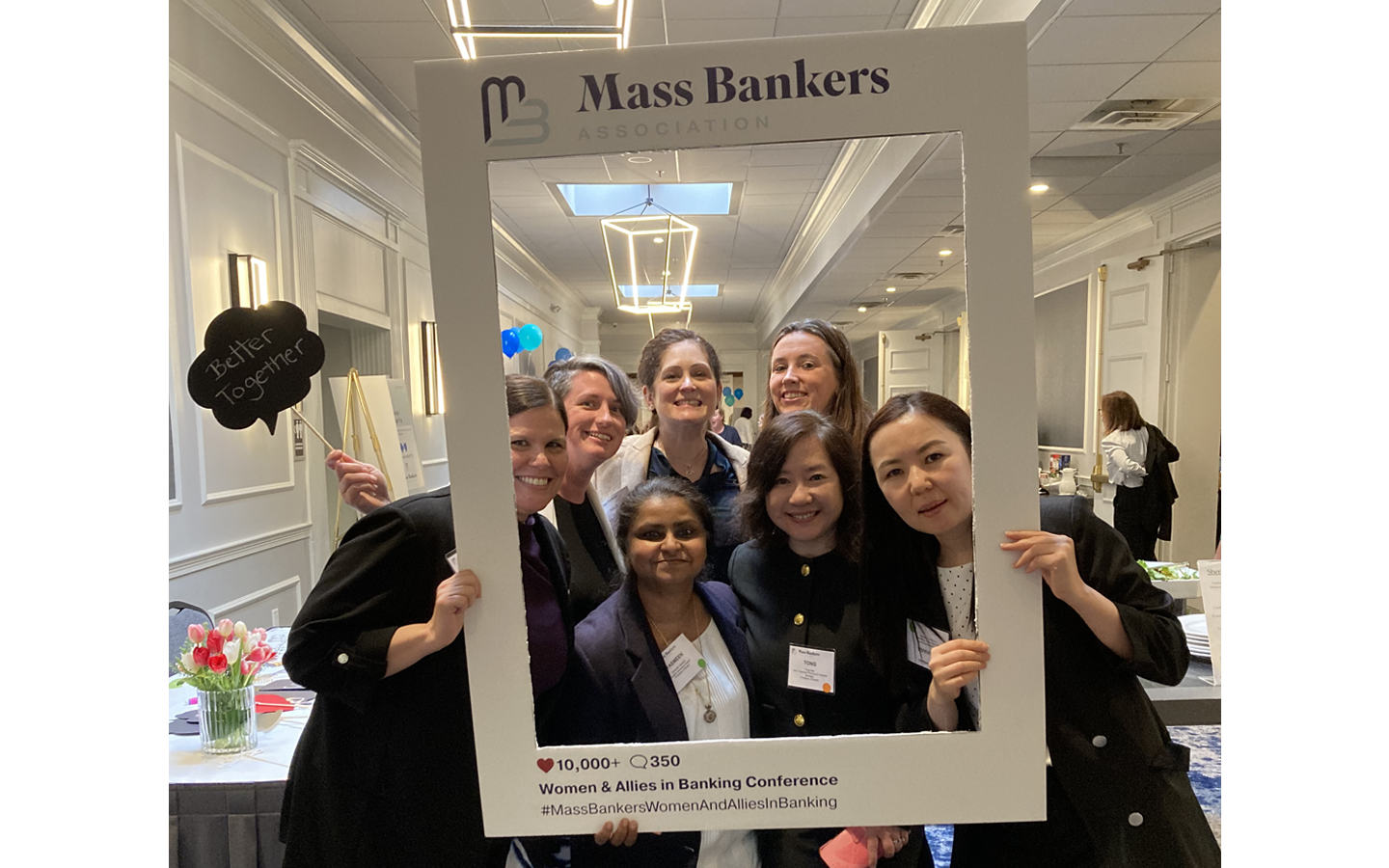
Massachusetts Bankers Association
FHLBank Boston sponsored the Massachusetts Bankers Association’s Women & Allies in Banking Conference, which was attended by Bank employees.
Catie’s Closet
Catie’s Closet gives children access to clothing and basic necessities so they can thrive in school and life. Bank volunteers helped sort clothing by size, gender, and type so it can be distributed to those who need it most.
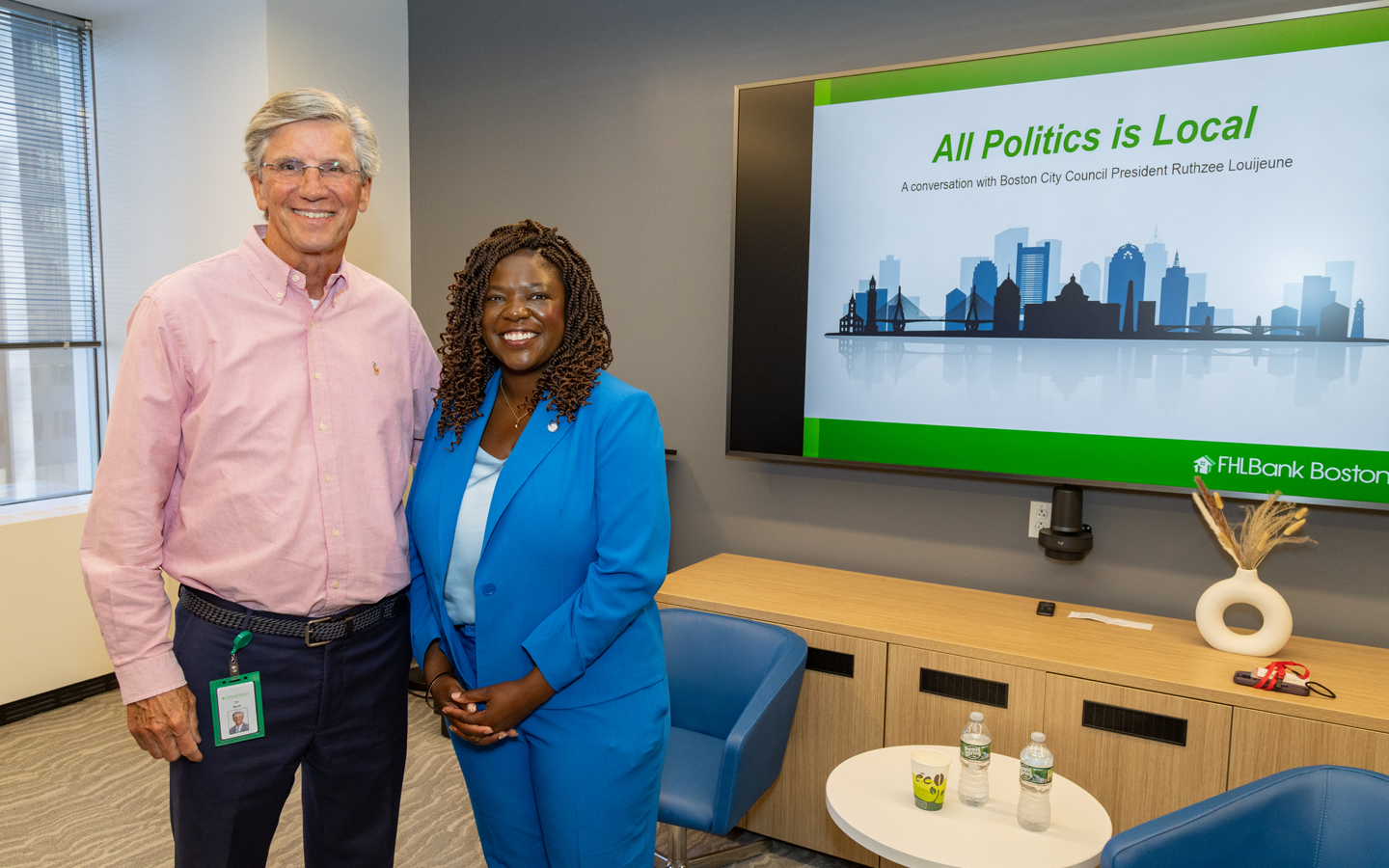
A Conversation with Boston City Council President
The Bank hosted an event with Boston City Council President Ruthzee Louijeune called “All Politics is Local.” It was attended by many in the Bank, including President, Chief Executive Officer Timothy J. Barrett, who is pictured with Louijeune above.
Winter Walk
Employees joined more than 3,000 walkers for the Winter Walk to fight homelessness and support Bridge Over Troubled Waters, an organization that assists homeless and at-risk youth.
Intern Build for Habitat for Humanity
Bank interns came together to help build a Habitat for Humanity home.
Christmas in the City
FHLBank Boston sponsored backpacks and volunteered for Christmas in the City to support Boston-area families experiencing homelessness and poverty.
Advisory Council Report
Affordable Housing Program
The Affordable Housing Program (AHP) turned 35 years old in 2025. Since its beginning, the program has supported the creation or preservation of 40,089 affordable homes. In 2025 alone, direct subsidy support, combined with low-interest funding, helped create or preserve 23% more affordable homes in New England than the previous year. Forty-nine initiatives serving low- and moderate-income individuals, families, seniors, those with disabilities, and formerly homeless people benefited from AHP funding. Watch the video below to hear how a Maine bank and local partner have benefited from the program and learn more about this important program’s impact on the New England economy.
Transcript
We’re in need of housing. There’s no question, and affordability is a real challenge for many. For more than 20 years now, I’ve been working with the Federal Home Loan Bank and the AHP program. The program is helping us to create more housing in our communities.
The Affordable Housing Program is a capital grant and interest rate subsidy program specifically designed to build affordable rental and homeownership housing for low- to moderate-income individuals and households. One of the things I love about our program is that this is private capital funding. It’s generated through the Bank’s earnings. So, this isn’t a public subsidy that’s governed by a different process. This is actually the Bank putting its money where its mouth is.
Before the pandemic, the Affordable Housing Program really was valuable in helping Maine Housing spread their limited resources around the state and build more affordable housing. Since the pandemic, it’s become critical to helping us address the steep rise in construction costs.
What it effectively does is it buys down the interest rate from current market rates. We’re generally seeing a 2 to 3% discount on the rate. When you have a 40-unit apartment building that was very costly to build, if it had just all traditional debt structured against it, that would be a real cost burden, and you’d have to have higher rents to be able to support all of the costs. By minimizing the cost of the debt payment after the traditional operating costs, you can now offer those lower rents.
AHP has had a significant impact in New England, from veterans’ housing to special needs housing to homeless housing to cooperatives to seniors’, manufactured housing. We’ve seen it all over the 35 years of the program. The money has facilitated the development of over 40,000 homes throughout New England. These are real people, these are teachers, firefighters, civil service workers that are living in affordable, safe, decent homes to support their lives.
Federal Home Loan Bank of Boston is an amazing partner. They’re very flexible, they always work with us. They also bring their funding in earlier in the projects, helping us leverage funds and make our dollars stretch farther. It’s an amazing partnership, and we couldn’t do what we do without the Federal Home Loan Bank of Boston.
It’s been exciting to work with the Federal Home Loan Bank and be a part of so many of these.
Developers in the affordable housing sector are tremendously committed, passionate about their work. It’s uplifting and motivating.
I’ve been in this for close to 30 years now, and there’s nothing more satisfying than going to a ribbon cutting or a dedication, and people are so grateful and so thankful that the Bank was able to provide a grant because they now have a place to live. Nothing makes you feel better than that.
The money has facilitated the development of over 40,000 homes throughout New England. These are real people. These are teachers, firefighters, civil service workers that are living in affordable, safe, decent homes to support their lives.
Kenneth Willis Senior Vice President, Director of Housing & Community Investment
FHLBank Boston
Affordable Housing Program Data
2025 Low-Interest Advances
$12,770,883
2025 Grants & Subsidies
$34,249,501
2025 Affordable Housing Intiatives
49
2025 Affordable Homes
1,532
1990-2025 Low-Interest Advances
$365,271,886
1990-2025 Grants & Subsidies
$463,988,184
1990-2025 Affordable Housing Initiatives
1,384
1990-2025 Affordable Homes
40,089
State
Awards
Number of Projects
*Number of Units
CT
$4,096,307 in grants, loans, and interest-rate subsidies
3
125
ME
$15,185,271 in grants, loans, and interest-rate subsidies
12
375
MA
$20,334,913 in grants, loans, and interest-rate subsidies
24
616
NH
$378,892 in grants, loans, and interest-rate subsidies
1
6
RI
$1.7 million in grants
2
158
VT
$2,975,000 in grants
4
124
*Number of affordable units lists is as reported by members; number of units refers to affordable units only.
Connecticut
110 Washington, Hartford, Massachusetts Housing Investment Corporation, Boston Communities, Arch Communities LLC, 57 rental units, $750,000 grant
Church Street Commons, Hebron, Liberty Bank, NDC Housing and Economic Development Corporation, Commons Community Development Corporation, 48 rental units, $850,000 grant
Dresser Woods, Salisbury, Torrington Savings Bank, Salisbury Housing Committee, Inc., 20 rental units, $1,196,307 grant and subsidy, $1.3 million loan
Maine
Belmont Avenue Apartments, Belfast, Bangor Savings Bank, Waldo Community Action Partners, 40 rental units, $850,000 grant
Quebec Commons, Biddeford, Maine Community Bank, Westbrook Development Corporation, Westbrook Housing Authority, 40 rental units, $1,199,822 grant and subsidy, $1,200,000 loan
Varney Heights, Freeport, Bath Savings Institution, Freeport Housing Trust, Inc., 42 rental units, $749,842 grant
Winter Street Apartments, Lisbon, Norway Savings Bank, Realty Resources Development LLC, Coastal Affordable Housing, 42 rental units, $980,930 grant and subsidy, $350,000 loan
Harding Family Homes, Orland, Bangor Savings Bank, Homeworkers Organized for More Employment, 6 rental units, $390,000 grant
Cumberland Housing, Portland, Bath Savings Institution, Portland Housing Authority, Portland Housing Development Corporation, 40 rental units, $1,194,897 grant and subsidy, $1.2 million loan
Mayo Housing, Portland, Norway Savings Bank, Portland Housing Authority, Portland Housing Development Corporation, 27 rental units, $1,197,009 grant and subsidy, $12 million loan
Prosperity Place, Portland, Maine Community Bank, ProsperityME, Developers Collaborative, 50 rental units, $850,000 grant
School Street Apartments, Saco, Bangor Savings Bank, Quality Housing Coalition, 7 rental units, $455,000 grant
Stratton Court, Scarborough, Maine Community Bank, South Portland Housing Development Corporation, South Portland Housing Authority, 43 rental units, $1,199,116 grant and subsidy, $1.2 million loan
Meeting House Hill Apartments, Waldoboro, Bangor Savings Bank, Volunteers of America, Northern New England, Inc., 36 rental units, $850,000 grant
Duplex Condo 3 Carrean, Waterville, First National Bank, Waterville Community Land Trust, 2 homeownership units, $119,360 grant
Massachusetts
416 Great Road, Acton, All One Credit Union, Habitat for Humanity North Central Massachusetts, Inc., 3 homeownership units, $900,000 grant
Pequoig House, Athol, The Bank of Canton, Fairview Housing Partners, EJR Health LLC, 11 CTL LLC, 53 rental units, $850,000 grant
25 Bridge Street, Boston, Eastern Bank, Bridge Over Troubled Waters, 64 rental units, $850,000 grant
7-9 Westminster Terrace, Boston, Eastern Bank, Planning Office for Urban Affairs, Inc., Roxbury Stone House, Inc., 13 rental units, $500,000 grant
Visions of Victory, Boston (Jamaica Plain), Eastern Bank, Victory Programs, Inc., 41 rental units, $850,000 grant
250 Seaver Street, Boston, Eastern Bank, The Commonwealth Land Trust, Inc., 16 rental units, $978,796 grant and subsidy, $980,000 loan
Brewster 3571 Main St. Community Housing, Brewster, Cape Cod Five Cents Savings Bank, Habitat for Humanity of Cape Cod, Inc., 2 homeownership units, $180,000 grant
Evergreen Circle, Erving, Greenfield Savings Bank, Rural Development, Inc., 26 rental units, $1,197,009 grant and subsidy, $1.2 million loan
Fairmont St. Projects, Fitchburg, Rockland Trust Company, Making Opportunity Count, Inc., 42 rental units, $850,000 grant
Birch Street Greenfield, Greenfield, Greenfield Co-Operative Bank, Pioneer Valley Habitat for Humanity, Inc., 1 homeownership unit, $75,000 grant
The Winslow PSH Preservation, Greenfield, Greenfield Savings Bank, Greenfield Housing Associates, Inc., 55 rental units, $200,000 grant
Massachusetts (continued)
Essex County Habitat 512 Washington Street Affordable Housing, Haverhill, Institution for Savings in Newburyport and its Vicinity, Essex County Habitat for Humanity, 7 rental units, $420,000 grant
Prosperity Way Stage Two, Housatonic (Great Barrington), Adams Community Bank, Central Berkshire Habitat for Humanity, 7 homeownership units, $630,000 grant
Tahattawan Road Littleton, Littleton, All One Credit Union, Habitat for Humanity North Central Massachusetts, Inc., 2 homeownership units, $70,000 grant
Broadway Supportive Housing II, Lowell, Eastern Bank, Common Ground Development Corporation, 37 rental units, $500,000 grant
5 Auburn Street, Natick, Eastern Bank, Metro West Collaborative Development, Inc., 32 rental units, $1,198,198 grant and subsidy, $3,440,883 loan
Linden Terrace Phase One A LLC, Needham, Citizens Bank, Affordable Housing and Services Collaborative, Inc., Peabody Housing LLC, 76 rental units, $850,000 grant
27 Crafts Ave., Northampton, Greenfield Savings Bank, Valley Community Development Corporation, 30 rental units, $850,000 grant
Bellevue Veterans Community, Oak Bluffs, Rockland Trust Company, Island Housing Trust Corporation,12 rental units, $800,000 grant
BC Arc VII Shaker Lane, Pittsfield, Pittsfield Co-Operative Bank, Berkshire County Arc, Inc., 4 homeownership units, $250,000 grant
Essex County Habitat for Humanity Homeowner Initiative Wenham, Wenham, Institution for Savings in Newburyport and its Vicinity, Essex County Habitat for Humanity, 2 homeownership units, $180,000 grant
Poland and Streeter Schools Redevelopment, Winchendon, Fidelity Co-Operative Bank, Montachusett Veterans Outreach Center, Incorporated, 44 rental units, $891,712 grant and subsidy, $500,000 loan
Colony on Grove, Worcester, Massachusetts Housing Investment Corporation, Colony Retirement Homes, Inc., Affirmative Investments, 45 rental units,$850,000 grant
521-523 Sunderland Rd., Worcester, Beacon Bank & Trust, Habitat for Humanity – Metrowest/Greater Worcester Inc., 2 homeownership units, $133,000 grant
New Hampshire
Kingston Veterans Residence, Kingston, Newburyport Five Cents Savings Bank, Housing Support, Inc., 6 rental units, $178,892 grant and subsidy, $200,000 loan
Rhode Island
160 Broad Street Apartments, Providence, Centreville Bank, Crossroads Rhode Island, 97 rental units, $850,000 grant
183 Washington/Preservation, West Warwick, Citizens Bank, Women’s Development Corporation, 61 rental units, $850,000 grant
Vermont
Three 33 Jones, Brandon, Bar Harbor Bank and Trust, Housing Trust of Rutland County, Inc., 29 rental units, $425,000 grant
Chalet Apartments, Brattleboro, Citizens Bank, Evernorth, Inc, Windham & Windsor Housing Trust, 31 rental units, $850,000 grant
Faywood Road, Grand Isle, Union Bank, Evernorth, Inc., Cathedral Square Corporation, 24 rental units, $850,000 grant
Newport Crossing, Newport, Community National Bank, Gilman Housing Trust, Inc., 40 rental units, $850,000 grant
Initiatives Outside of New England
Cleveland West Veterans Housing, Cleveland, Ohio, Citizens Bank, CHN Housing Partners, 62 rental units, $850,000 grant
Drueding Center Residential, Philadelphia, Pennsylvania, Citizens Bank, Drueding Center, 26 rental units, $850,000 grant
Winter West Affordable, Philadelphia, Pennsylvania, Citizens Bank, Philadelphia Chinatown Development Corporation, 40 rental units, $650,000 grant
Homeownership Assistance Programs
Buying a home remained challenging in New England for many households in 2025 due to elevated mortgage interest rates and high home prices. However, FHLBank Boston’s three down-payment assistance programs continued to help first-time homebuyers and borrowers with incomes below 80% of the area median income, as well as those earning more than 80% and up to 120% of the area median income, purchase homes. Liberty Bank in Connecticut has consistently used the programs to assist homebuyers with varying incomes. By engaging in FHLBank Boston’s homeownership assistance programs, Liberty Bank has delivered measurable, positive outcomes, promoting its mission to improve the lives of its customers and communities.
Liberty Bank’s use of FHLBank Boston’s programs for down-payment and closing cost assistance has enabled our borrowers to overcome upfront cost barriers and achieve sustainable homeownership. By leveraging high-impact grants like FHLBank Boston’s Equity Builder Program, Housing Our Workforce, and their Lift Up grant, our loan officers consistently maximize FHLBank Boston’s programs to support as many of our qualified borrowers as possible. These programs not only strengthen affordability for our customers but also enhance our community lending mission by directing meaningful financial support to households across a wide range of income levels.
Fanita Borges
First Vice President
Liberty Bank
Equity Builder Program
In 2025, the Equity Builder Program (EBP), helped 139 more buyers purchase their first home than the prior year. Homeowners with incomes up to 80% of the area median income used EBP grants for down payments, closing costs, and rehabilitation expenses.
Equity Builder Program Data
2025 Grants Committed
$7,017,784
2025 Member Participants
70
2025 Homebuyers
282
2003-2025 Grants Committed
$69,082,962
2003-2025 Member Participants
190
2003-2025 Homebuyers
5,023
Connecticut
American Eagle Financial Credit Union
Charter Oak Federal Credit Union
Connex Credit Union
CorePlus Federal Credit Union
First County Bank
Liberty Bank
Newtown Savings Bank
Northwest Community Bank
Thomaston Savings Bank
Torrington Savings Bank
Webster Bank, N.A.
Windsor Federal Bank
Maine
Bangor Savings Bank
Katahdin Federal Credit Union
Katahdin Trust Company
Kennebec Savings Bank
Maine Savings Federal Credit Union
Massachusetts
Adams Community Bank
Athol Credit Union
bankESB
bankHometown
Bay State Savings Bank
BayCoast Bank
Beacon Bank & Trust
Bluestone Bank
Cambridge Savings Bank
Cape & Coast Bank
Cornerstone Bank
Dean Co-Operative Bank
Dedham Institution for Savings
East Cambridge Savings Bank
Eastern Bank
Fall River Five Cents Savings Bank
Fidelity Co-Operative Bank
Greenfield Co-Operative Bank
Greylock Federal Credit Union
Harvard Federal Credit Union
Institution for Savings in Newburyport and its Vicinity
Leader Bank, N.A.
Lee Bank
Mechanics Cooperative Bank
Metro Credit Union
Millbury Federal Credit Union
MountainOne Bank
North Shore Bank, A Co-Operative Bank
Northern Bank & Trust Company
PeoplesBank
Pittsfield Co-Operative Bank
Rockland Trust Company
Salem Five Cents Savings Bank
St. Mary’s Credit Union
The Bank of Canton
The Cooperative Bank
Winter Hill Bank, FSB
New Hampshire
Bellwether Community Credit Union
Claremont Savings Bank
Mascoma Bank
Sugar River Bank
Rhode Island
BankNewport
Centreville Bank
Citizens Bank, N.A.
The Washington Trust Company
Vermont
Community National Bank
EastRise Federal Credit Union
Green Mountain Credit Union
National Bank of Middlebury
NorthCountry Federal Credit Union
Passumpsic Savings Bank
Union Bank
Vermont Federal Credit Union
*State reflects members’ headquarters. Some members on this list disbursed grants in more than one state.
Housing Our Workforce
Housing Our Workforce increased its down-payment assistance by more than $2.2 million in 2025, committing $7,320,021 to households earning more than 80% and up to 120% of the area median income. In the last year, 296 households received assistance from the program.
Housing Our Workforce Data
2025 Grants Committed
$7,320,021
2025 Member Participants
73
2025 Homebuyers
296
2019-2025 Grants Committed
$25,378,246
2019-2025 Member Participants
112
2019-2025 Homebuyers
1,284
Connecticut
American Eagle Financial Credit Union
Charter Oak Federal Credit Union
Chelsea Groton Bank
Connex Credit Union
Dime Bank
First County Bank
Liberty Bank
Newtown Savings Bank
Northwest Community Bank
Webster Bank, N.A.
Windsor Federal Bank
Maine
Bangor Savings Bank
Bar Harbor Bank and Trust
Bath Savings Institution
Katahdin Federal Credit Union
Katahdin Trust Company
Kennebec Savings Bank
Maine Community Bank
Maine Savings Federal Credit Union
Norway Savings Bank
University Credit Union
Massachusetts
Adams Community Bank
Athol Credit Union
bankESB
bankHometown
Bay State Savings Bank
BayCoast Bank
Bluestone Bank
Cambridge Savings Bank
Cape & Coast Bank
Cornerstone Bank
Dean Co-Operative Bank
Dedham Institution for Savings
East Cambridge Savings Bank
Eastern Bank
Fall River Five Cents Savings Bank
Fidelity Co-Operative Bank
Greenfield Co-Operative Bank
Greenfield Savings Bank
Greylock Federal Credit Union
Harvard Federal Credit Union
Haverhill Bank
Institution for Savings in Newburyport and its Vicinity
Leader Bank, N.A.
Metro Credit Union
North Easton Savings Bank
North Shore Bank, A Co-Operative Bank
Pentucket Bank
PeoplesBank
Pittsfield Co-Operative Bank
Rockland Trust Company
Salem Five Cents Savings Bank
St. Mary’s Credit Union
The Bank of Canton
The Cooperative Bank
Webster Five Cents Savings Bank
Winter Hill Bank, FSB
New Hampshire
Bellwether Community Credit Union
Claremont Savings Bank
Mascoma Bank
Salem Co-Operative Bank
Rhode Island
BankNewport
Centreville Bank
Citizens Bank, N.A.
The Washington Trust Company
Vermont
Community National Bank
EastRise Federal Credit Union
Green Mountain Credit Union
National Bank of Middlebury
NorthCountry Federal Credit Union
Northfield Savings Bank
Union Bank
Vermont Federal Credit Union
*State reflects members’ headquarters. Some members on this list disbursed grants in more than one state.
Lift Up Homeownership
The Lift Up Homeownership program helped 149 first-generation homebuyers with down-payment and closing-cost assistance in 2025. To qualify for the program, all homebuyers must have incomes up to or below 120% of the area median income, and the homebuyer must also certify that the parents and/or legal guardian of at least one borrower does not currently own a home in the United States and has not previously owned a home in the United States, or at least one borrower has aged out of foster care.
Lift Up Homeownership Data
2025 Grants Committed
$7,320,021
2025 Member Participants
39
2025 Homebuyers
149
2023-2025 Grants Committed
$14,820,021
2023-2025 Member Participants
49
2023-2025 Homebuyers
304
Connecticut
American Eagle Financial Credit Union
First County Bank
Liberty Bank
Newtown Savings Bank
Northwest Community Bank
Thomaston Savings Bank
Webster Bank, N.A.
Windsor Federal Bank
Maine
Bangor Savings Bank
Katahdin Trust Company
Massachusetts
Adams Community Bank
bankESB
BankFive (legal name is Fall River Five Cents Savings Bank)
bankHometown
Bay State Savings Bank
BayCoast Bank
Bluestone Bank
Cambridge Savings Bank
Cape & Coast Bank
Cornerstone Bank
Eastern Bank
Fidelity Co-Operative Bank
Greenfield Co-Operative Bank
Greylock Federal Credit Union
Leader Bank, N.A.
Lee Bank
Metro Credit Union
Pittsfield Co-Operative Bank
Rockland Trust Company
Rollstone Bank & Trust
Salem Five Cents Savings Bank
St. Mary’s Credit Union
The Bank of Canton
Rhode Island
BankNewport
The Washington Trust Company
Vermont
EastRise Federal Credit Union
Green Mountain Credit Union
Union Bank
Vermont Federal Credit Union
*State reflects members’ headquarters. Some members on this list disbursed grants in more than one state.
Community Development Advance
Member use of the Community Development Advance (CDA) Program increased in 2025, contributing to the development or preservation of 113% more housing units and 26.3% more economic development or mixed-use initiatives than in 2024. This discounted financing program was used by members to support a range of initiatives, including the preservation of nine income-restricted rental units in Boston, the redevelopment of a courthouse into 46 new affordable rental units in Central Falls, Rhode Island, and the construction of 47 apartments for tenants with incomes at or below 80% of the area median income in Terryville, Connecticut.
Community Development Advance Program Data
2025 Advances
$739,287,953
2025 Housing Units
1,041
2025 Economic Development or Mixed-Use Initiatives
72
1990-2025 Advances
$24,062,702,166
1990-2025 Housing Units
128,320
1990-2025 Economic Development or Mixed-Use Initiatives
2,009
This investment helps protect homes, strengthen families, and preserve affordability in a neighborhood facing real displacement pressure. By partnering with FHLBank Boston, we are keeping Naturally Occurring Affordable Housing in our region and ensuring that the buildings are leased to an organization providing critical transitional housing. This is what impact looks like when mission-driven capital meets local leadership.
Moddie Turay
President, Chief Executive Officer
Massachusetts Housing Investment Corporation
Community Development Financial Institution Advance
The Community Development Financial Institution (CDFI) Advance program strengthens partnerships between members and non-depository CDFIs. It supports the development of affordable housing, job creation and small business growth, and the expansion of community facilities in distressed New England communities. In two years since the program began, FHLBank Boston provided $50.9 million in advances and $11.5 million in subsidies to 28 member institutions, which were directed to support programs of local CDFIs.
Community Development Financial Institution Advance Data
2025 Advances
$26,556,075
2025 Subsidy
$6,953,262
2025 Participating Members
22
2024-2025 Advances
$50,906,075
2024-2025 Subsidy
$11,527,304
2024-2025 Participating Members
28
Our partnership with FHLBank Boston is a true collaboration that enables us to fulfill our mission of supporting community-based enterprises.
Gina Maroni
Senior Vice President, Chief Financial Officer
UMassFive College Federal Credit Union
From Pop Up to Permanence
When Wooden Cooperative – a worker-owned restaurant and bakery based in Worcester, MA – sought capital in 2025 for renovations, retail expansion, and equipment purchases to scale its food service and baking production, its cooperative ownership structure made traditional financing unavailable. Recognizing this challenge, Wooden Cooperative’s Community Development Financial Institution partner, Cooperative Fund of the Northeast (CFNE), reached out to UMassFive College Federal Credit Union.
UMassFive College Credit Union, an FHLBank Boston member, applied for an interest-free advance through the CDFI Advance program to deliver the capital needed to bring the project to fruition.
“UMassFive was proud to underwrite a loan to CFNE and facilitate more of their work. Our partnership with FHLBank Boston is a true collaboration that enables us to fulfill our mission of supporting community-based enterprises,” said Gina Maroni, senior vice president and CFO of UMassFive College Federal Credit Union.
Wooden Cooperative, formerly known as Wooden Noodle, is a worker-owned restaurant and bakery established in 2018 as a pop-up concept. The enterprise transitioned to a permanent cooperative restaurant in 2021. Subsequently, it merged with an existing bakery, significantly expanding both production and retail capacity. In 2024, the cooperative comprised six worker-owners and 21 employees, generating $693,000 in combined revenue from the restaurant and bakery.
To support its continued growth, Wooden Cooperative partnered with CFNE, which provides financing and technical assistance to cooperatives and employee-owned businesses in the northeast.
CFNE provided a $35,000 revolving line of credit, which enabled Wooden Cooperative to complete required buildout improvements associated with a $75,000 City of Worcester forgivable equipment grant.
The project strengthened and stabilized operations, preserving and creating quality jobs within a democratic, worker-owned model. In addition, the cooperative offers affordable commercial space to local artisans and emerging food entrepreneurs, fostering small business incubation and contributing to Worcester’s local food ecosystem. Located within a CDFI-qualified investment area, Wooden Cooperative plays a meaningful role in advancing inclusive economic development, workforce opportunity, and community-based ownership.
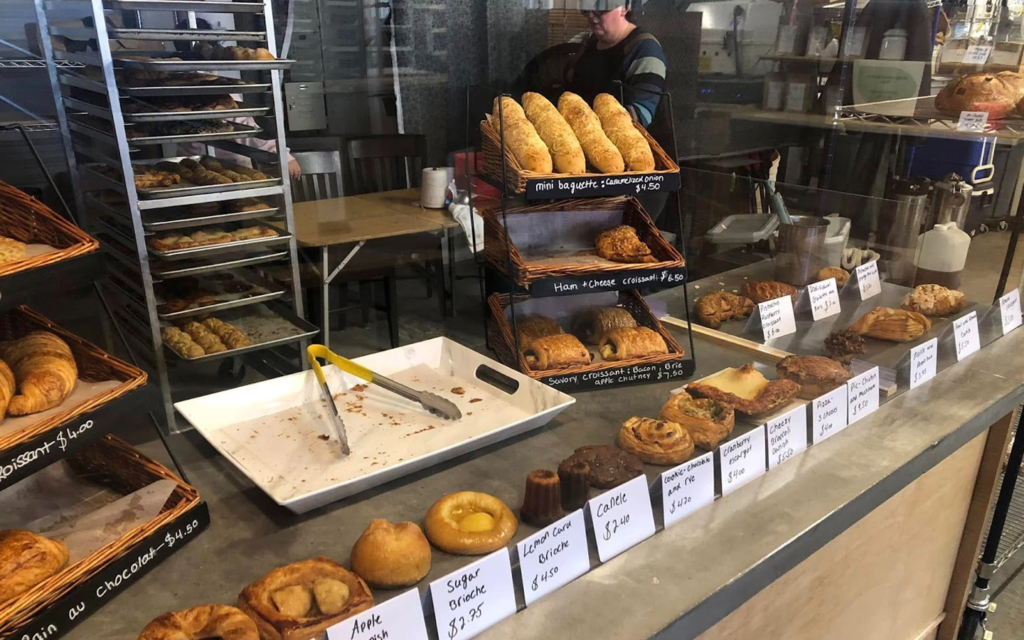
Baked goods on display at Wooden Cooperative in Worcester, MA.
Jobs for New England
Jobs for New England (JNE) supports economic development across New England by helping members assist local small businesses that create and preserve jobs in their communities. With JNE’s below-market-rate financing, members can provide low-cost loans to help businesses purchase needed equipment, upgrade facilities, and expand. Since the program’s inception in 2016, JNE has supported the creation or preservation of 15,260 jobs.
Jobs for New England Data
2025 Advances
$32,361,986
2025 Subsidy
$5,410,700
2025 Participating Members
44
2025 Jobs Created/Preserved
1,526
2016-2025 Advances
$396,734,357
2016-2025 Subsidy
$44,595,467
2016-2025 Participating Members
110
2016 Jobs Created/Preserved
15,260
*Job numbers as reported by members.
Union Bank’s $140,000 Jobs for New England Advance for Pie Fixes Everything, LLC (Poorhouse Pies) supported equipment purchases and renovations for a second location. At least nine jobs will be added, including two executive chefs. The new large production kitchen will enable the business to meet the demand for pies, donuts, and full-service catering. Owner, Suzanne Tomlinson (a/k/a Pie Lady), expects to nearly double revenues and provide a small seating area for patrons and community members to socialize.
Rebecca (Becky) Stebbins
Assistant Vice President, Commercial Loan Officer
Union Bank
Grants for New England Partnerships
The Grants for New England Partnerships program reflects FHLBank Boston’s commitment to banks and credit unions to help strengthen local communities. In 2025, $25,000 grants were awarded to 10 members who supported 14 local nonprofit organizations, including those focused on affordable housing, people with mental health challenges, and places providing shelter for domestic violence survivors.
Grants for New England Partnerships Data
2025 Grants
$25,000
2025 Members
10
2025 Nonprofit Organizations
14
Grants for New England Partnerships Recipients
Member
Nonprofit Organization
Aroostook County Federal Savings & Loan Association
Homeless Services of Aroostook
Bank of New Hampshire
NeighborWorks Southern New Hampshire
Berkshire Bank
The Urban League of Greater Hartford
Cambridge Savings Bank
Greater Lowell Family YMCA
Kennebunk Savings Bank
Fair Tide
Mascoma Bank
Vermont Community Loan Fund
Massachusetts Housing Investment Corporation
Housing Corporation of Arlington
Merrimack County Savings Bank
Marguerite’s Place
Merrimack County Savings Bank
Overcomers Refugee Services
Merrimack County Savings Bank
Family Promise of Southern New Hampshire
Merrimack County Savings Bank
National Alliance on Mental Illness New Hampshire (NAMI New Hampshire)
Merrimack County Savings Bank
The Granite YMCA
MHIC, LLC
The Neighborhood Developers, Inc.
Partners Bank
Sanford-Springvale YMCA
At Bank of New Hampshire, we are dedicated to partnerships that make a meaningful difference in the communities we have proudly served for over 194 years. We are honored to select NeighborWorks Southern New Hampshire for FHLBank Boston’s Grants for New England Partnerships program, recognizing the vital work they do to improve financial stability for individuals and families in southern New Hampshire. Their mission aligns closely with our commitment to building stronger, more resilient communities and supporting local families in need of safe, affordable housing.
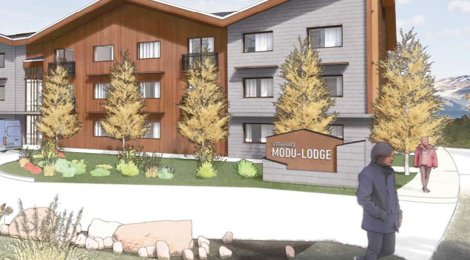
FHLBank Boston looks to the future of housing with the Affordable Housing Development Competition. Graduate students collaborate with sponsors and mentors to create practical, community-focused housing proposals that bridge academic theory and industry practice. Marking its 25th year, the 2025 competition drew seven entries from students with interests in architecture, real estate, planning, finance, and policy. Winning proposals included a multi-purpose one- and two-bedroom residential living facility for seniors and live-in caregivers in South Boston; a community of single-room occupancy units, studios, and two-bedroom units for hospitality industry workers in Jay, Vermont; and the transformation of a half-acre lot in Putney, Vermont, into six affordable homeownership units. Learn more about the competition’s 25-year history in the video below.
Transcript
Housing is the biggest issue locally, statewide, and nationally. It affects our economy, it affects how people live, it affects their opportunities for schooling, for employment.
The Affordable Housing Development Competition connects graduate students from a variety of different universities and colleges with a nonprofit developer. Over a course of about six and a half to seven weeks, they take a project that’s in that developer’s pipeline and develop a very comprehensive proposal that includes detailed renderings, development budgets, timeline, and more.
As the sponsor, we get a really talented team of Boston area students who will evaluate the site as we would do as developers. To have that quality proposal, to be able to show all of the financial stakeholders and elected officials and city government and neighbors, that this is a real potential use for the site, and that’s what makes the competition so valuable to a nonprofit sponsor.
We’re working with students from UMass Boston, Harvard, MIT, the Boston Architectural Collaborative, to Clark, Wentworth, and UMass Amherst. We have proposals from all over New England. We have downtown Boston. We have Northern Maine. We have Connecticut. We have Martha’s Vineyard. There is a need for affordable housing everywhere.
The work to develop affordable housing is so complex. You’re working with so many different kinds of people in different disciplines, whether it’s in city government, state government, banks. All of those pieces have to come together, and the students get to see exactly how that works.
Hearing from students saying that this has been the most valuable experience in their graduate school career has really been like super affirming for me and rewarding but also knowing that we really are helping to create that next generation of affordable housing professionals.
I’ve hired students. I know they’ve been hired by my peer community development organizations and other developers of affordable housing. It’s fun to see some of the affordable housing development competition students as they launch their careers around Boston.
Most meaningful to me in the work we’re doing with the Bank and the competition is ensuring that going forward, we have people committed to affordable housing that know how to make it happen. It’s a win-win situation for the community, the developer, and the students.
We’ve been so fortunate to have great sponsors who come back year after year, and we really couldn’t do it without all of them at the table helping to support the effort. Kudos to the Bank for having brought the concept of this competition through fruition and created an event that can withstand 25 years.
Knowing that we really are helping to create that next generation of affordable housing professionals is rewarding.
Tobi Goldberg
Sr. Community Investment Manager
FHLBank Boston
2025 Winning Proposals
The Mosaic South Boston, MA
First Place: $10,000 – The Mosaic aims to convert South Boston High School into 83 units of low-income senior housing and residential community spaces, including a rooftop garden, games and arts room, fitness center, and large multipurpose space.
Workforce Modu-Lodge Jay, VT
Second Place: $7,000 – Workforce Modu-Lodge provides a flexible mix of modular-construction single-room occupancy units, studios, and two-bedroom units in Jay for seasonal and year-round workers in the hospitality industry.
Eva Mondon Commons Putney, VT
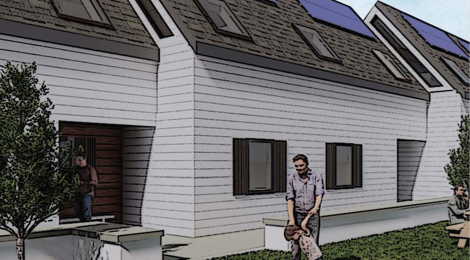
Third Place: $4,000 – Eva Mondon Commons is intended to transform a half-acre rural Vermont lot into six affordable homeownership units.
Housing Competition Sponsors
Federal Home Loan Bank of Boston
Boston Society for Architecture
CohnReznick LLP
Kuehn Charitable Foundation
ICON Architecture, Inc.
Citizens’ Housing and Planning Association
Our Leaders
The leadership team is anchored by the Management Committee and board of directors, which consist of member directors elected by members in each of the six New England states, as well as independent directors nominated by the board. Board directors use their expertise in financial services, housing and community development, real estate, and cybersecurity to guide the Bank’s strategic priorities, oversee the budget and key policies, and ensure the safety and soundness of operations. The management committee and board are advised by the 15-member Advisory Council, comprising housing and development leaders focused on the Affordable Housing Program and community investment.
Edward F. Manzi, Jr. (Retired September 2025) Chairman, Chief Executive Officer Fidelity Cooperative Bank Leominster, MA
John C. Witherspoon (Vice Chair) Director Skowhegan Savings Bank Kingfield, Maine
Kevin D. Miller President, Chief Executive Officer Profile Bank Rochester, New Hampshire
Duncan Barnard Chief Internal Auditor CLS Bank New York, New York
William M. Parent Chief Strategy Officer bankESB Quincy, Massachusetts
Donna L. Boulanger Director North Brookfield Savings Bank North Brookfield, Massachusetts
David Rotatori President, Chief Executive Officer Ion Bank Naugatuck, Connecticut
Michael A. Brown Rear Admiral, United States Navy (Ret.) Retired Cybersecurity Executive Seabrook, New Hampshire
E. Macey Russell Retired Law Partner Newton, Massachusetts
Caroline R. Carpenter President, Chief Executive Officer National Bank of Middlebury Middlebury, Vermont
Robert Tourigny Executive Director NeighborWorks Southern New Hampshire Manchester, New Hampshire
Thomas J. Curry Retired Law Partner and Bank Regulator Osterville, Massachusetts
Gregg C. Tumeinski Executive Vice President, Chief Financial Officer The Beacon Mutual Insurance Company Warwick, Rhode Island
Antoinette C. Lazarus Vice President, Compliance Conning Hartford, Connecticut
Executive Committee
Chairman:
Eric Chatman
Vice Chairman:
John C. Witherspoon
Committee Chairs:
Duncan Barnard
*Caroline R. Carpenter
Thomas J. Curry
Antoinette C. Lazarus
Kevin D. Miller
William M. Parent
E. Macey Russell
Audit Committee
Chair:
Duncan Barnard
Vice Chairman:
*William M. Parent
Committee:
Antoinette C. Lazarus
Kevin D. Miller
Robert Tourigny
Finance Committee
Chair:
Kevin D. Miller
Vice Chairman:
David Rotatori
Committee:
Duncan Barnard
Michael A. Brown
John C. Witherspoon
Governance/Government Relations Committee
Chair:
Thomas J. Curry
Vice Chairman:
Antoinette C. Lazarus
Committee:
Donna L. Boulanger
Kevin D. Miller
Robert Tourigny
John C. Witherspoon
Housing & Community Development Committee
Chair:
E. Macey Russell
Vice Chairman:
Robert Tourigny
Committee:
Michael A. Brown
Caroline R. Carpenter
Thomas J. Curry
Gregg Tumeinski
Human Resources & Compensation Committee
Chair:
Antoinette C. Lazarus
Vice Chairman:
Thomas J. Curry
Committee:
Donna L. Boulanger
William M. Parent
E. Macey Russell
John C. Witherspoon
Risk Committee
Chair:
*Caroline R. Carpenter
Vice Chair:
*David Rotatori
Committee:
Donna L. Boulanger
E. Macey Russell
Gregg Tumeinski
Technology Committee
Chair:
William M. Parent
Vice Chair:
Michael A. Brown
Committee:
Duncan Barnard
Caroline R. Carpenter
David Rotatori
Gregg Tumeinski
Council of Federal Home Loan Banks
Timothy J. Barrett
Eric Chatman
John C. Witherspoon
The chair of the Board is an ex-officio member of all committees of the Board. However, the chair is not counted in determining the number of committee members necessary to constitute a quorum; but, if present, the chair is counted for purposes of establishing a quorum at any such committee meeting and is entitled to vote unless otherwise provided in a committee’s charter.
*Assumed additional board leadership responsibilities upon Edward F. Manzi’s retirement.
Daniel Brennan (Chair) Director Maine State Housing Authority Augusta, Maine
Katherine Easterly Martey Executive Director New Hampshire Community Development Finance Authority Concord, New Hampshire
Jeanne Cola (Vice Chair) Executive Director Local Initiatives Support Corporation – Rhode Island Providence, Rhode Island
Joshua R. Meehan Executive Director Keene Housing Keene, New Hampshire
Elizabeth Bridgewater Executive Director Windham & Windsor Housing Trust Brattleboro, Vermont
Cathy Mercado Executive Director Merrimack Valley Housing Partnership Lowell, Massachusetts
Rodger L. Brown Jr. Managing Director of Real Estate Development Preservation of Affordable Housing, Inc. Boston, Massachusetts
Sharon Morris Executive Director Omni Development Corporation Providence, Rhode Island
Maura Collins Executive Director Vermont Housing Finance Agency Burlington, Vermont