News for Insurance Companies
Welcome to our third-quarter 2026 newsletter exclusively for insurance company members of FHLBank Boston.
Bullet vs. Amortizing Advances: Which Fits Your Strategy?
Insurance companies use FHLBank Boston advances to fund investments, manage liquidity, support liabilities, and optimize cash flow. While rates and terms matter, the advance structure can be just as important.
Bullet Advances: Stable Funding
With a bullet advance, principal is repaid at maturity, and interest is paid periodically throughout the term. This preserves the full borrowing amount until maturity, providing stable funding and maximizing investable capital.
Best suited for:
- Funding long-duration fixed-income investments;
- Maintaining liquidity flexibility during periods of market uncertainty;
- Supporting institutional products with known future maturity dates; and
- Preserving invested assets and maximizing earning potential.
Amortizing Advances: Matching Cash Flows
With an amortizing advance, principal is repaid gradually over a schedule. As the balance declines, funding costs and collateral requirements decrease.
Best suited for:
- Managing declining liabilities;
- Funding commercial or residential mortgage portfolios; and
- Supporting runoff business.
Choosing the Right Structure
There is no one-size-fits-all solution. The optimal structure often depends on your assets, liabilities, and liquidity objectives. Many insurers use a mix of bullet and amortizing advances to better align funding with their asset-liability-management strategy.
The Bottom Line
The right advance should do more than provide funding. It can support your broader balance sheet strategy. By evaluating how principal repayment schedules align with asset cash flows, liability runoff patterns, and liquidity objectives, insurance companies may be able to improve asset-liability-management outcomes and make more efficient use of their FHLBank Boston borrowing capacity.
Cash Settlement Dates: Plan for Your Funding Needs
FHLBank Boston offers various funding solutions, each with its own settlement schedule. Understanding when funds settle can help you better manage liquidity and funding needs.
Reminder: Advance rates are reduced by three basis points when transactions are executed before 12:00 p.m.
| Settlement Timing | Eligibility / Cut-Off Time | Products |
|---|---|---|
| Same-Day Settlement | Transaction initiated by 5:00 p.m. | Daily Cash Manager |
| Same-Day Settlement | Transaction initiated by 12:00 p.m. | Classic Advance (Bullet) Amortizing Advance Community Development Advance SOFR-Indexed Advance HLB-Option Advance Member-Option Advance |
| Next-Day Settlement | Transaction initiated before 12:00 p.m. | Symmetrical Prepayment Advance |
| Next-Day Settlement | Transaction initiated between 10:00 and 10:45 a.m. on Tuesdays and Thursdays | Discount Note Auction-Floater Advance |
| Up to Two-Year Settlement | Based on advance start date | Forward Starting Advance |
Letters of Credit: Flexible Credit Support for Insurers
FHLBank Boston Standby Letters of Credit (LOCs) provide insurance companies with a secure, cost-effective alternative to traditional bank-issued letters of credit. Backed by the financial strength of the FHLBank System, LOCs can help insurers meet collateral, reinsurance, contractual, and other credit-support requirements while preserving liquidity and investment flexibility.
Benefits include:
- Strong issuer credit quality;
- Regulatory and industry acceptance;
- FHLBank Boston’s letters of credit are NAIC-approved;
- Preservation of cash and liquid assets; and
- Competitive pricing and operational flexibility.
As insurers focus on capital efficiency, liquidity management, and contingent funding capacity, FHLBank Standby LOCs offer a flexible solution to a variety of business needs.
Learn more: Letters of Credit
Hurricane Season – Be Prepared for Liquidity Needs
Hurricane season can create significant cash demands as claim payments are made before reinsurance recoveries, investment maturities, or other expected inflows are received. FHLBank Boston can provide contingent liquidity to help bridge temporary cash flow gaps.
Severe weather events can create sudden and significant cash demands. Insurers may experience elevated claim payments, policyholder withdrawals, or other unexpected outflows. Even well-capitalized companies can encounter timing mismatches between when cash must be paid and when cash is received.
Recent catastrophe losses highlight the liquidity challenge:
Data on catastrophic losses underscore the size and speed of these liquidity demands. According to Swiss Re Institute, insured catastrophic losses exceeded $100 billion globally in 2025, marking the sixth consecutive year above that threshold.
For insurers, the takeaway is clear: catastrophe-related cash demands are becoming more frequent and more severe.
How FHLBank Boston advances can help:
- Bridging the gap between claim payments and reinsurance recoveries;
- Funding catastrophe-related claim obligations;
- Managing temporary operating cash shortfalls; and
- Preserving investment portfolios during market volatility.
Plan before liquidity is needed:
As weather-related events continue to create uncertainty across the insurance industry, FHLBank Boston remains committed to providing members with dependable liquidity and funding flexibility. Insurance company members should review their liquidity contingency plans and evaluate how FHLBank funding can strengthen preparedness for hurricane season and other unexpected events.
Advance Interest and LOC Fee Payment Timing
Please note the following payment schedules for advance interest and Letters of Credit (LOC) fees:
- Bullet Advances: Second business day of the following month
- Amortizing Advances: First business day of the following month
- Discount Note Auction-Floater Advances: Next index reset date (28 or 91 days)
- SOFR Floating Advances: Two business days after the one-year anniversary or at maturity, if sooner
- LOCs: First business day after the LOCs effective date
Understanding these payment dates can help support effective cash flow and liquidity planning.
Advance Renewal Discount
To better support your funding strategy and help you reduce interest expenses, FHLBank Boston is pleased to provide discounted rates for advances that are rolled into a new Classic Advance at maturity.
Discount schedule:
- 50% to 124% of the maturing advance amount: 2 basis point discount
- 125% or more of the maturing advance amount: 4 basis point discount
Applies to new Classic Advances with terms of 18 months to 30 years. Discount amounts are subtracted from the applicable posted rate.
Members must contact the Member Funding Desk at 800-357-3452 (option 1) between 10:00 a.m. and 3:00 p.m., two business days prior to the maturity of the existing advance.
Please Note:
- Advance Renewal Discounts are not available through Online Banking.
- The posted rate in effect at the time you call the Member Funding Desk, versus the rate when the current advance matures, will be used to determine the rate of your new advance. Remember that rates are 3 bp lower before 12 p.m.
Welcome New Members
Since the spring newsletter, FHLBank Boston has welcomed the following new insurance company members:
- College Insurance Company, Colchester, VT
- RiverStone International Insurance, Inc., Beverly, MA
Borrowing through Online Banking
Members are encouraged to use Online Banking when borrowing. It provides a more efficient process by allowing members to request an advance and wire the funds as part of the same transaction, eliminating the two-step process of calling the Funding Desk and then completing the required wire instructions separately.
Note: Members must call the Member Funding Desk at 800-357-3452 (option 1) for floating rate advances, advances with optionality, or advance transactions of $300 million or more.
Enroll in OKTA to Maintain Online Banking (OLB) Access
To enhance the security of OLB, FHLBank Boston will require all users to use application-based authentication beginning in the fourth quarter of this year. Currently, application-based authentication is only required for wire transactions.
To ensure uninterrupted access to OLB, all users should switch to application-based authentication with our service provider Okta as soon as possible. To assist with this transition, please refer to our application-based authentication guide.
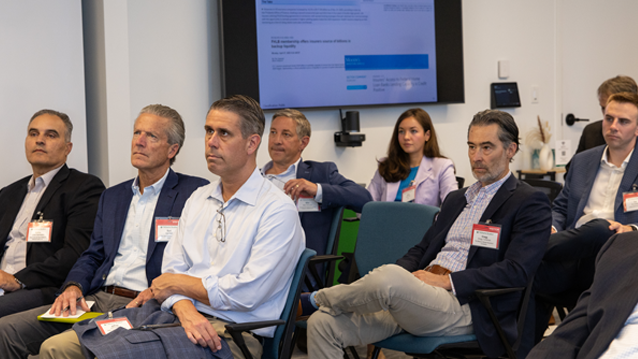
Capital Markets Insights for Insurance Leaders
FHLBank Boston hosted insurance members for a discussion on capital markets followed by a reception in Boston. In this picture, insurance company members listen as funding and liquidity insights are shared.
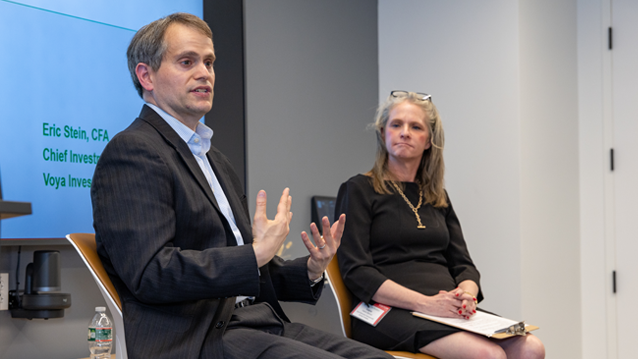
Eric Stein and Valerie Bannon
Eric Stein, CFA, chief investment officer, Voya Investment Management, and Valerie Bannon, senior insurance client portfolio strategist, Voya Retirement Insurance & Annuity Company, share their perspectives during a panel discussion at a recent FHLBank Boston insurance company member event.

Ana Dyer, Valerie Bannon, and Matt Stewart
Participants of the capital markets discussion were invited to a networking reception. Pictured are Ana Dyer, FHLBank Boston senior vice president, chief business officer; Valerie Bannon, senior client portfolio strategist at Voya Retirement Insurance & Annuity Company; and Matt Stewart, FHLBank Boston vice president, director of sales, at the View Boston observation deck.