
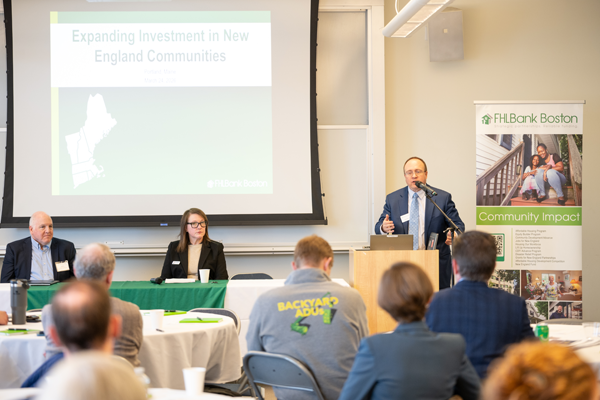
Expanding Investment Across New England
Across New England, the need for more housing is being felt in every community. Rising costs, constrained supply, and sustained demand have made it increasingly difficult for many households — particularly first-time homebuyers and those with lower incomes — to find homes they can afford. In response, housing leaders across the region are coming together to identify practical, scalable solutions.
Earlier this year, FHLBank Boston convened a series of forums, bringing together developers, lenders, policymakers, and housing practitioners to share perspectives and explore how to increase housing production across the region. While each state faces distinct challenges, a consistent theme emerged: New England’s housing constraints are deeply interconnected and so too are the opportunities to address them.
The Affordable Housing Advisory Council played a central role in shaping these conversations, contributing as keynote speakers, panelists, and thought leaders. Their perspectives grounded the discussions in real-world experience while highlighting emerging approaches across the region.
Across the forums, participants returned to a core question: how can the region build more housing, more efficiently, and at price points that are attainable for a wider range of households?
In Maine, Dan Brennan, director of MaineHousing and chairman of FHLBank Boston’s Advisory Council, addressed the dual need to expand housing supply while preserving existing affordable units, including through tools such as the Maine Redevelopment Land Bank.
In New Hampshire, Elissa Margolin, director of the Institute for Housing Policy and Practice at Saint Anselm College, discussed the growing public focus on housing affordability, ongoing zoning reform efforts, and insights from the state’s zoning atlas — particularly the role that large-lot zoning and limited access to water and sewer infrastructure play in constraining development and rehabilitation.
Across the forums, participants returned to a core question: how can the region build more housing, more efficiently, and at price points that are attainable for a wider range of households? Construction costs remain elevated, driven by material prices, land constraints, and delays associated with zoning and permitting processes. At the same time, there is a growing recognition that increasing supply must go hand in hand with preserving and reinvesting in existing affordable housing.
Policymakers and practitioners pointed to a range of tools already being deployed. Those include:
- expanded bonding authority
- housing tax credits
- targeted policy reforms designed to streamline development
These efforts are helping to create a more supportive and predictable environment for housing production — an important factor for lenders and investors evaluating new opportunities.
One area that generated significant interest was modular, or offsite, construction. By building housing units in controlled factory environments and assembling them on-site, developers may be able to improve efficiency, reduce waste, and shorten construction timelines. At the same time, participants emphasized that success depends on early coordination among developers, lenders, and project teams to ensure that the approach aligns with site conditions and financing structures.
At the Worcester, Massachusetts, forum, Jessica Boatright, interim CEO of Opportunity Communities, offered a forward-looking perspective on how the industry can evolve. She emphasized that cost efficiency and design quality need not be in conflict, and that the sector has an opportunity to rethink long-standing development practices. In her view, the greatest constraint is often not a lack of resources, but a hesitation to reimagine how housing is planned, financed, and delivered.
Boatright pointed to pilot projects — particularly those using modular construction — as a way to test new models, build confidence among lenders, and support broader adoption. She also highlighted the importance of aligning financing structures with these approaches, noting that offsite construction often requires earlier deployment of capital than traditional development.
Beyond increasing supply, participants underscored the importance of expanding access to homeownership. For many first-time and first-generation buyers, the process remains complex and difficult to navigate. A more coordinated, “concierge-style” model — linking homebuyer education, financing, and post-purchase support — emerged as one promising approach. By strengthening collaboration among lenders, Realtors, and housing counselors, stakeholders can help create a more seamless and accessible homebuying experience.
Looking ahead, FHLBank Boston plans to build on the momentum of these conversations through continued engagement, education, and resource development.
As New England continues to confront its housing challenges, one message from the forums was clear: lasting progress will depend on collaboration across sectors. By aligning capital, policy, and innovation, stakeholders have an opportunity to expand housing supply and broaden access to opportunity across the region.
Article contributed by Theo Noell, FHLBank Boston assistant vice president, outreach, research, compliance
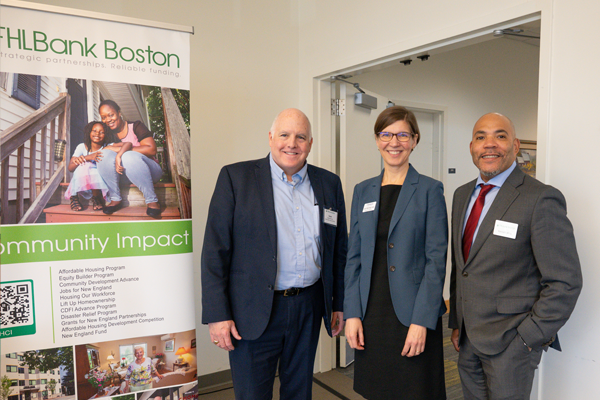
Portland, Maine Forum
One of the well-attended forums that FHLBank Boston hosted took place at the University of Southern Maine in Portland. Pictured above is MaineHousing Director Dan Brennan with The Genesis Fund Executive Director Liza Fleming-Ives, and FHLBank Boston Senior Vice President, Director of Housing and Community Investment Kenneth Willis. Brennan and Fleming-Ives also serve on FHLBank Boston’s Advisory Council.
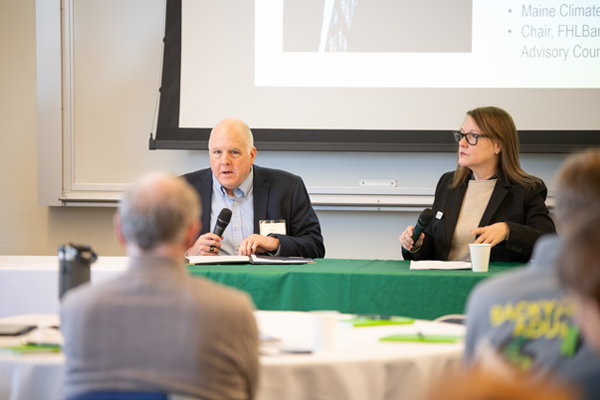
Panel Discussion
MassHousing Director Dan Brennan spoke about the need to expand housing supply while also preserving existing affordable housing stock. Here he is pictured with Maine Redevelopment Land Bank Deputy Director Jennifer Litteral.
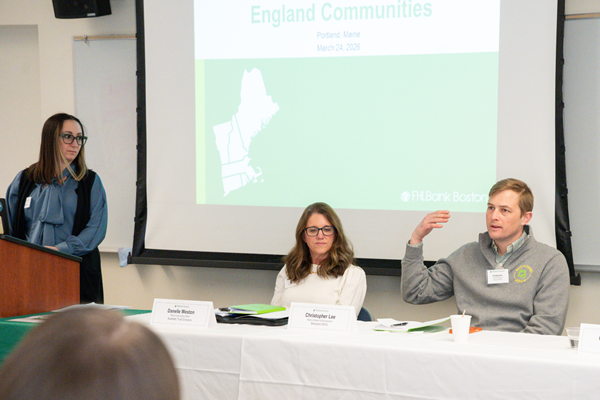
Homeownership Panel
FHLBank Boston Homeownership Set-Aside Programs Manager Kaitlyn Mulhern moderated a panel that included Danielle Weston, vice president, retail underwriting at Katahdin Trust and Company, and Chris Lee, head of design and development at Backyard ADUs.
